As a higher-education institution prepared to move Banner to Ellucian SaaS, it had to determine how to preserve a custom eligibility process that depended heavily on the on-premises Banner database.

The process identified which students qualified for a term-based benefit and recorded that eligibility as a student attribute, a Banner record value used here as the system-of-record indicator of eligibility. TouchNet, the institution’s payment system, read that attribute in real time as part of the downstream payment workflow.
Because the customization combined business rules, direct data access, configuration and attribute updates inside the on-premises environment, the SaaS transition required more than replacing SQL queries with API calls. The institution needed to preserve the required eligibility behavior and its downstream use while redesigning how the process obtained data, evaluated policy, updated Banner and recorded processing outcomes.
ABCloudz rebuilt the customization as an externally orchestrated, API-driven workflow with separate responsibilities for Banner data access, eligibility processing, transactional updates, operational state and reporting.

Rebuild the custom Banner eligibility process for Ellucian SaaS while preserving the institution-specific business behavior and the Banner eligibility state used downstream by TouchNet.
RELATED BLOG POST: For another Banner modernization connected to TouchNet, this time focused on custom student billing, statement generation and downstream billing distribution, see Modernizing custom Banner student billing with TouchNet for Ellucian SaaS.
A custom eligibility process had grown into a database dependency
The legacy customization was a custom Banner Job Submission batch process that ran database-side logic and combined several responsibilities in one database-driven implementation. It read identity, registration, curriculum, academic standing and enrollment-status data directly from Banner tables. SQL and PL/SQL, Oracle’s procedural extension of SQL, applied institution-specific eligibility rules. A custom configuration table controlled term-by-term requalification behavior, while qualifying students received the eligibility attribute through direct database inserts.
That attribute mattered beyond the batch itself. It represented the student’s eligibility state in Banner and was read in real time by TouchNet, the institution’s payment system, as part of downstream payment processing. It also supported other institutional processes related to program administration and fulfillment. The attribute alone did not mean that the student had completed payment.
The rules also continued to evolve. Eligibility depended on academic and enrollment conditions, while data timing could affect decisions when current-term status information was not yet available.

Business policy, Banner data access, attribute updates, custom configuration and operational reporting were concentrated in one custom database-driven batch process.
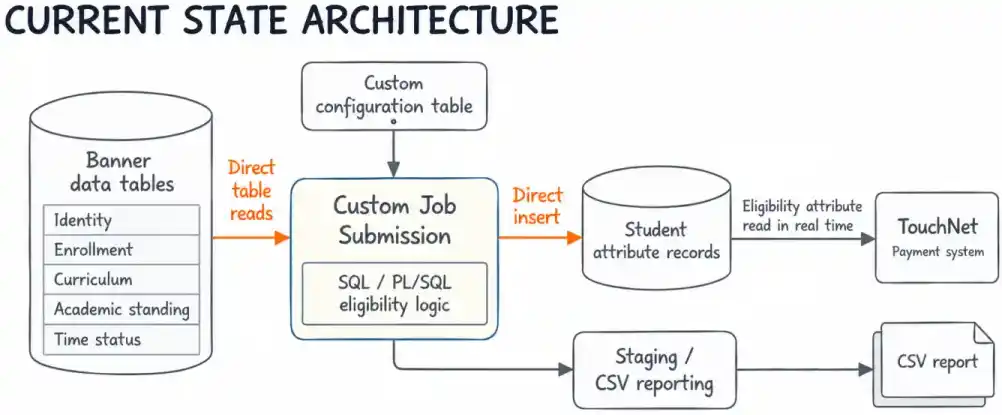
The modernization effort started by identifying the behavior the customization provided: determine eligibility from institutional policy, record the appropriate state in Banner and make the outcome available to operational users. Those responsibilities then had to be reassigned to SaaS-compatible components.
Redesigning the batch job as a SaaS eligibility workflow
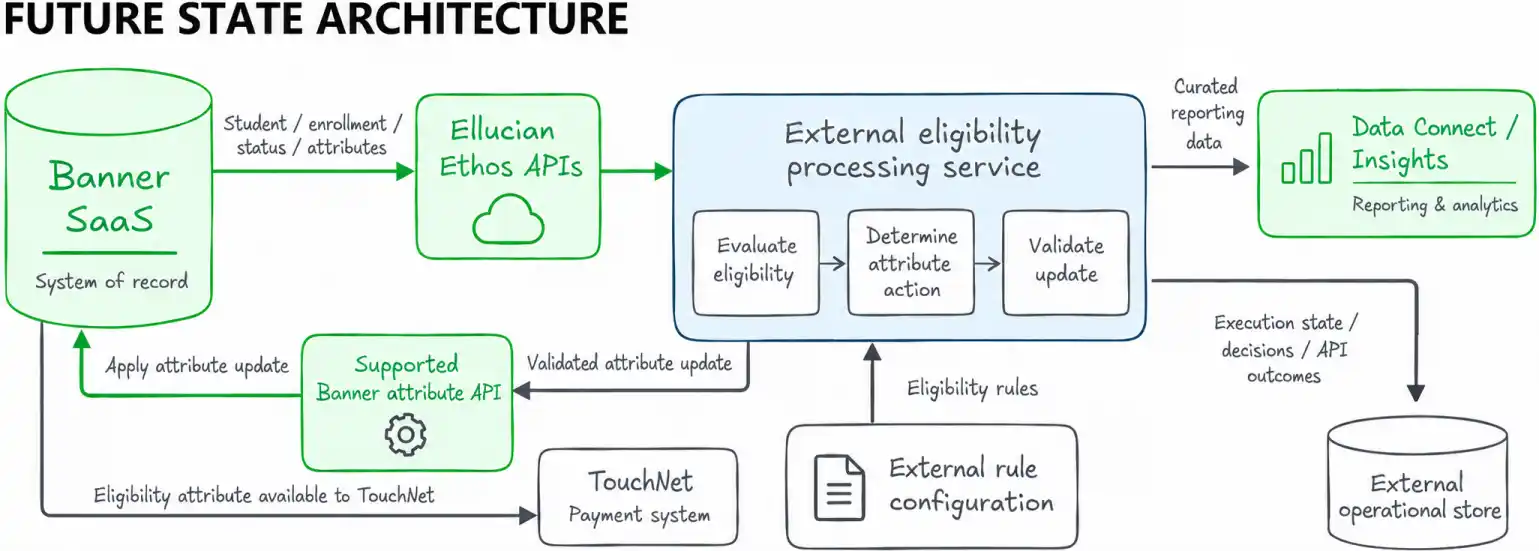
ABCloudz decomposed the legacy job into distinct responsibilities: retrieve system-of-record data, evaluate institutional policy, determine the required attribute action, submit transactional changes, retain operational state and publish reporting data. The redesign also preserved the Banner eligibility attribute as the downstream state used by TouchNet.
That separation became the organizing principle of the new architecture.

When modernizing a custom enterprise batch process for SaaS, first separate the business responsibilities embedded in the customization. The replacement architecture can then assign each responsibility to the appropriate supported component.
Separate data access from eligibility logic
Supported Ellucian Ethos APIs, part of Ellucian’s integration framework for accessing and exchanging data through supported interfaces, provide the student, enrollment, academic-program, academic-standing and existing-attribute data required by the workflow. The eligibility rules remain outside the API layer.
An external processing service aggregates and derives the information needed for evaluation, applies institution-specific inclusion and exclusion rules and determines the student’s final eligibility state. Rule definitions are maintained through an external configuration layer rather than embedded in database-resident code.
This separates institutional policy from Banner data storage and allows the eligibility framework to evolve without rebuilding a custom PL/SQL process.

The workflow had to preserve term-specific eligibility behavior and the resulting Banner state used downstream by TouchNet while replacing database identifiers, custom configuration and direct writes with supported SaaS mechanisms.
Update Banner only when the evaluated state requires it
After eligibility is calculated, the workflow compares the desired state with the student’s existing attribute state. A new attribute is created only when the student is eligible and the corresponding assignment does not already exist.
RELATED BLOG POST: For another student-state workflow that compares the required outcome with current Banner state before making supported API changes, see Modernizing a Point and Click Solutions immunization integration for Ellucian SaaS.
Before submission, the workflow validates the required identifiers and term context, checks for duplicates within the current run, confirms business-rule consistency and verifies the completeness of the API request payload.
The write itself uses a supported Banner API. One important implementation detail is that the API requires Banner academic-program and study-path context rather than accepting the same internal identifiers used by the legacy SQL process.

Make reruns observable, controlled, and safe
The Future State also moves processing state outside Banner. An external operational store records evaluated students, eligibility decisions, attribute actions, API outcomes, errors and execution metrics. This keeps pipeline metadata separate from the Banner business record and provides the information needed for traceability and controlled reprocessing.
Idempotency is built into the decision flow. Repeated execution can produce the same intended state without automatically creating another attribute record because the workflow checks current state before creating one.
Reporting is handled separately. Curated eligibility outcomes and operational data can be published through Ellucian Data Connect and downstream analytics tools, while transactional eligibility processing remains in the external workflow and supported Banner APIs.
What the new architecture changes
The institution retained its custom eligibility capability in an architecture designed for Ellucian SaaS. Eligibility policy is no longer embedded in Banner database code, attribute writes use supported APIs and repeated processing accounts for existing state before creating records. The resulting eligibility attribute remains in Banner as the downstream state used by TouchNet for payment processing.
Operational decisions and API outcomes are retained outside the Banner business record, providing traceability and supporting controlled reprocessing. Reporting is also separated from transactional execution, giving Data Connect and analytics platforms a clear downstream role.

The custom eligibility process now separates policy evaluation, Banner transactions, operational state and reporting into clear responsibilities while preserving the business function the institution needed in its SaaS environment, including downstream TouchNet use of the Banner eligibility attribute.
Frequently asked questions
Modernizing a custom Banner process for SaaS?
Custom Banner jobs can contain much more than legacy code. They may encode institutional policy, operational dependencies, data relationships and downstream business behavior. ABCloudz can help identify what a customization actually does, determine what must be preserved or redesigned and rebuild that capability using supported Ellucian SaaS architecture patterns.
Contact ABCloudz to discuss your Banner SaaS modernization project.