A U.S.-based cloud and software engineering organization needed a faster and more consistent way to modernize complex enterprise integrations without sacrificing engineering control. ABCloudz implemented Akaden, a human-supervised agentic engineering environment that combines project context, specialized agents, engineering tools, and Amazon Bedrock-based model inference.
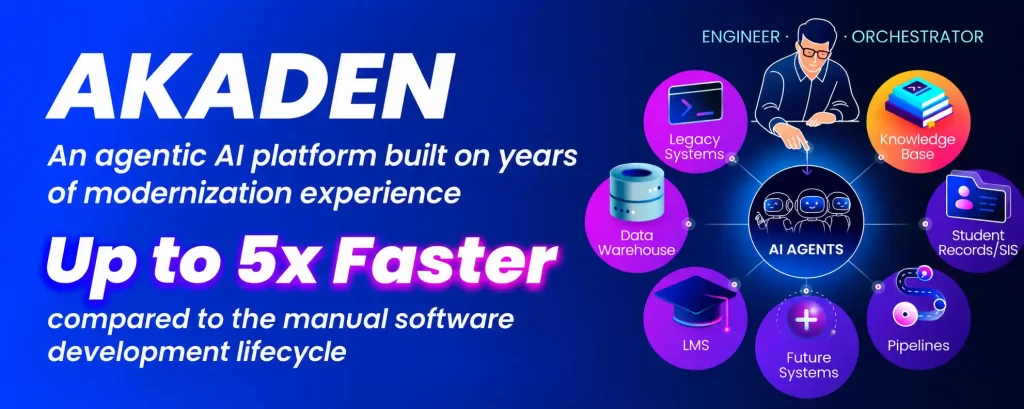
The solution helps engineers analyze legacy implementations, generate and refine integration artifacts, test and troubleshoot pipelines, and move validated changes toward deployment. Based on an internal survey of six ABCloudz engineers, comparable development work estimated at 824 hours using the previous workflow was estimated at 164 hours with the agentic environment, reducing development time to roughly one-fifth of the original effort, or about 5× faster.
About the customer
The customer is a U.S.-based cloud and software engineering organization that develops and maintains complex enterprise integrations and modernization solutions. Its engineering teams regularly work with legacy applications, APIs, source code, integration pipelines, technical specifications, and SaaS environments, including projects that require translating long-standing business logic into modern integration patterns.
Customer challenge
Complex integration modernization requires more than generating new code. Engineers first need to understand existing behavior, dependencies, business rules, data transformations, error handling, and operational assumptions. They then need to reproduce that behavior using supported APIs and SaaS-compatible integration patterns.
A representative workflow involved migrating a legacy integration dependent on direct database access into a SaaS-based integration environment. The existing implementation handled data, compliance logic, holds, conditional processing, error handling, and other business rules that had to be preserved while direct database access was replaced with supported API-driven patterns.
The traditional process required substantial manual effort across analysis, coding, configuration, credential handling, testing, debugging, documentation, and repeated navigation between development tools. This increased engineering effort and made complex modernization work more dependent on each developer’s familiarity with the legacy implementation.
The organization wanted to reduce this manual effort without allowing AI-generated changes to bypass engineering review. The target operating model was not autonomous deployment. Instead, engineers would move from executing every development step themselves toward supervising an agent-assisted workflow in which AI could perform substantial analysis and implementation work while humans retained responsibility for correctness and release decisions.
Partner solution
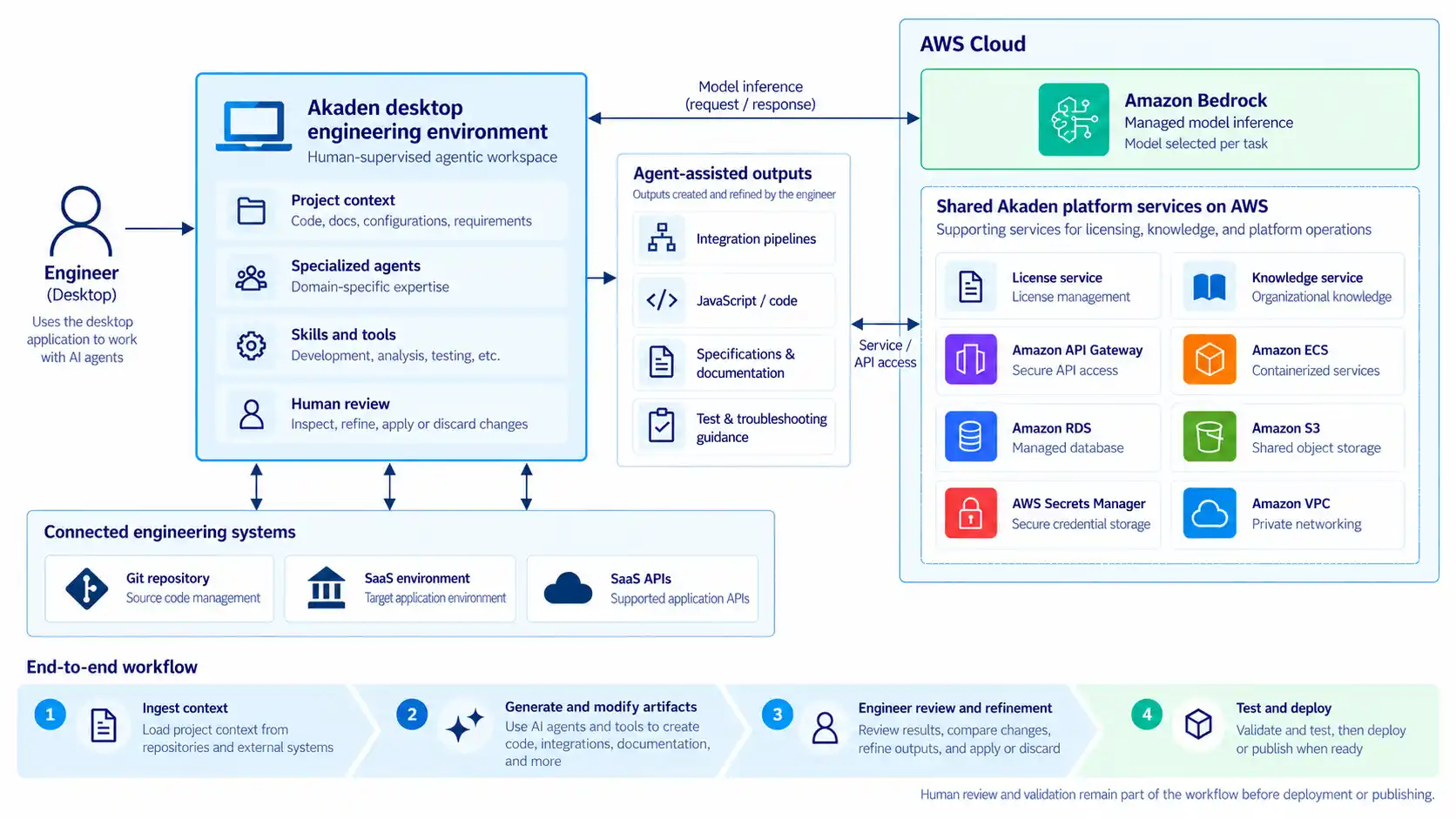
ABCloudz implemented Akaden as a desktop-first agentic engineering environment that brings project context, AI agents, engineering tools, and integration workflows together in one workspace.
Engineers can provide legacy source code, API documentation, requirements, specifications, reports, project files, and other implementation artifacts as context. Specialized agents, skills, and tools can then use that context to assist with requirements analysis, specification development, code and pipeline generation, testing, debugging, documentation, and implementation changes.
For AI inference, Akaden supports Amazon Bedrock as one of its primary managed model providers. The solution does not force engineers to use a single Foundation Model. For each AI task, an engineer can select any model available through the configured provider, making it possible to change models between tasks while keeping the surrounding engineering context, tools, and workflow consistent.
The platform also connects agents to the systems engineers already use. In the demonstrated integration workflow, the environment connected to a SaaS environment and its APIs, imported existing project artifacts from GitLab, analyzed legacy business logic, and generated a two-pipeline integration solution.
The engineer then reviewed and refined the generated pipelines, checked API behavior and error handling, deployed the selected version to a test environment, investigated failed executions, and iterated until the pipeline completed successfully.
Human control remains part of the workflow throughout the process. AI-generated changes are treated as proposals rather than automatically trusted modifications. Engineers can inspect differences, edit generated artifacts, apply or discard changes, validate the result against source requirements and legacy implementations, run tests, inspect execution results, and decide when an implementation is ready to be deployed or published.
AWS also supports shared platform services used by the engineering environment. License-management and knowledge-base services are hosted on AWS using Amazon ECS, Amazon RDS, Amazon API Gateway, Amazon S3, Amazon VPC private networking, and AWS secrets management. The knowledge service can dynamically provide relevant information to the engineering environment, while the broader AWS infrastructure supports shared data, service access, and platform operations.
Results and benefits
Internal engineering feedback indicates a substantial reduction in development effort after adopting the Akaden agentic workflow. Based on estimates provided by six ABCloudz engineers, comparable development work decreased from a combined 824 hours using the previous workflow to 164 hours with the agent-assisted environment, representing approximately a 5× improvement in development speed.
Individual engineering feedback supports the same pattern. In one representative migration estimate, overall effort decreased from approximately 60 hours to 40 hours. A significant portion of the remaining time was associated with communication and clarification rather than implementation itself, while the direct development work saw a greater relative improvement. Another engineer reported development becoming approximately 30% to 50% faster across three typical cases.
The environment also reduces repetitive manual work across development and testing workflows. Engineers can reuse execution parameters across repeated test runs, access credentials through centralized secrets management, and use AI assistance to generate JavaScript and integration components that would otherwise require manual implementation. This reduces routine setup work and allows engineers to spend more time on analysis, validation, and refinement.
Beyond development speed, engineers reported improvements in documentation, reverse engineering, and knowledge transfer. One developer estimated documentation work to be approximately 50% faster, while standardized project context and generated documentation made complex integrations easier for other engineers to understand and continue.
Production use has created a continuous feedback loop for improving the agentic workflow. Engineers share observations from real-world projects, including opportunities to improve business-rule interpretation, framework consistency, API selection, and preservation of existing logic. This feedback is incorporated into ongoing platform and agent-workflow improvements, helping the solution become more accurate, consistent, and effective over time.
About ABCloudz
ABCloudz, Inc. is a global technology firm providing solutions and services for managing data, applications, and infrastructure. With expertise across modernization, cloud, data engineering, AI/ML, analytics, and application delivery, we help institutions build secure, maintainable digital experiences that support real operational needs. Our focus on structured delivery, practical design, and long-term usability has earned the trust of customers across higher education and other industries.
ABCloudz is an AWS Advanced Tier Services Partner and holds the AWS Migration Competency, along with AWS Service Delivery specializations for AWS Database Migration Service, Amazon RDS, and Amazon CloudFront. The company also develops Generative AI and Agentic AI solutions using AWS AI services, including Amazon Bedrock, and has successfully completed AWS Foundational Technical Reviews for multiple GenAI solutions.
Reach out to our team at [email protected].