A U.S.-based enterprise technology organization needed a faster and more consistent way to understand heavily customized legacy ERP environments and plan complex modernization work.
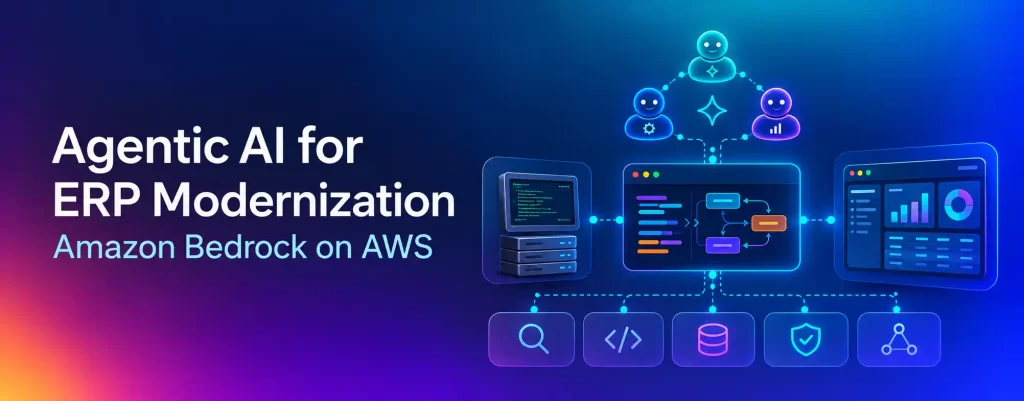
ABCloudz developed an AI-assisted engineering solution on AWS that combines deterministic system discovery, dependency analysis, retrieval-augmented generation, and custom multi-step agent workflows. Amazon Bedrock provides managed foundation-model inference, while Amazon ECS hosts the application services and custom agent orchestration.
The solution helps engineering teams move from identifying that a system was customized to understanding what changed, why it matters, how related components depend on one another, and how existing functionality can be addressed during modernization. Developer estimates indicate that analyzing and validating a typical integration or customization can decrease from approximately five to seven working days to about two days, depending on complexity.
About the customer
The customer is a U.S.-based enterprise technology organization working with complex business application environments.
The ERP environments in scope had evolved over many years and accumulated custom application logic, database code, integrations, scheduled processes, and organization-specific workflows. Understanding these environments requires more than identifying which objects differ from a reference baseline. Teams also need to determine the business purpose of customizations, reconstruct dependencies, identify integration boundaries, and understand how existing behavior should be addressed using current supported technologies.
Customer challenge
The customer’s earlier discovery process could identify application and database objects that had been modified relative to known reference baselines. This was valuable for establishing the scope of customization, but it did not fully explain what had changed inside the code, how modified objects interacted with other parts of the environment, or which business processes depended on them.
As a result, engineering and delivery teams still had to perform substantial manual analysis. They searched large inventories of application and database objects, interpreted legacy source code, traced dependencies and integration flows, investigated APIs, and assembled technical assessments and implementation plans. Without additional automation, discovery cycles could take longer, important dependencies could be missed, and modernization planning and decision-making could be delayed.
The challenge becomes especially significant when a customization participates in an integration. Understanding one modified object may require following a chain of source code, database objects, interfaces, and related logic before an engineer can determine how the functionality should be addressed. This work historically depended heavily on developers with deep knowledge of legacy Oracle PL/SQL and the surrounding application architecture.
The customer therefore needed a workflow that could combine comprehensive discovery with deeper technical interpretation. The goal was to let teams query discovered systems in natural language, compare objects, reconstruct flows, identify relevant APIs, and create repeatable technical assessments and implementation plans.
Our solution
ABCloudz designed the solution around a hybrid approach: deterministic discovery and dependency analysis provide the technical evidence, while AI helps engineers interpret that evidence and turn it into actionable modernization decisions.
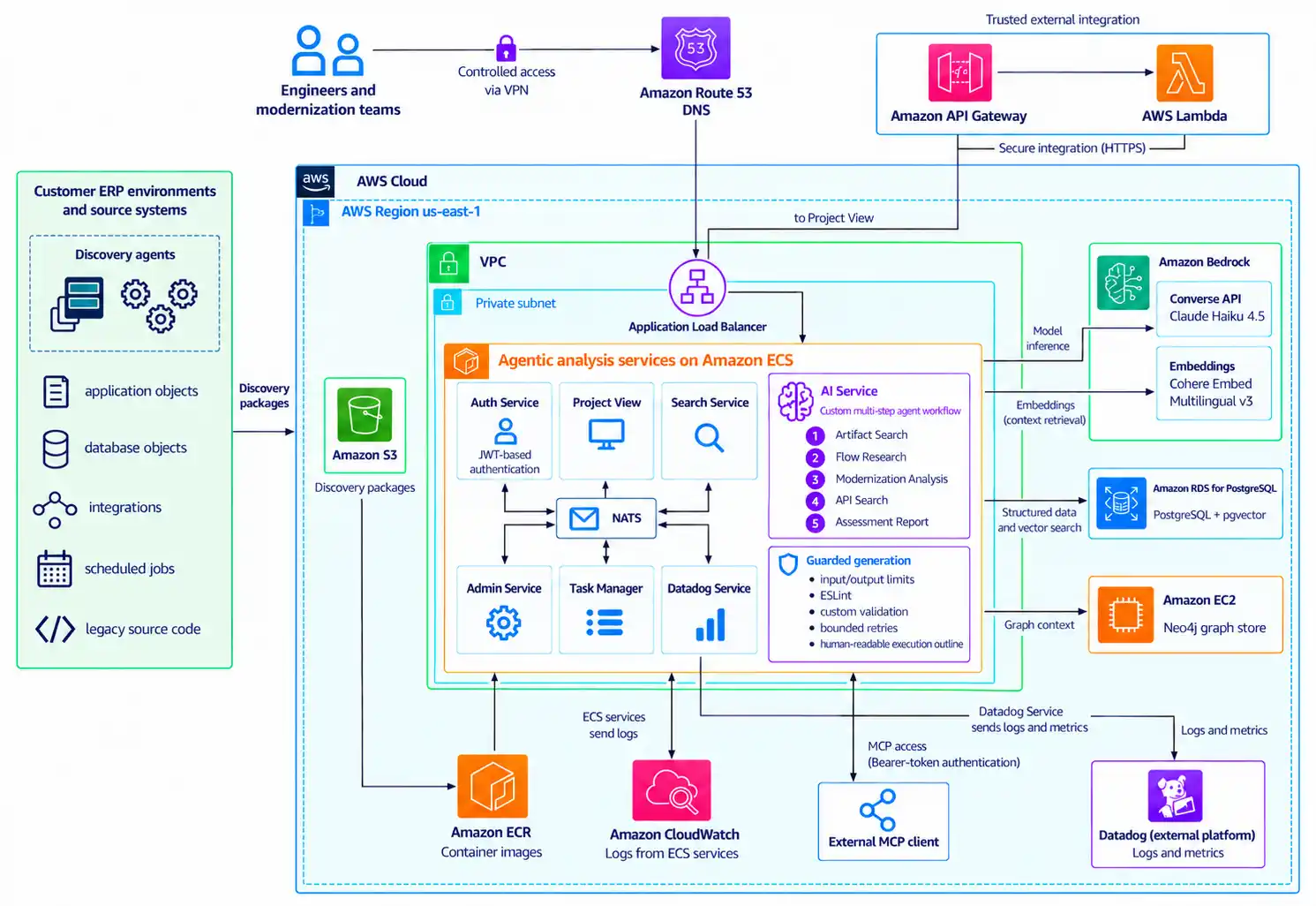
Lightweight discovery components collect structural information about customer environments and package it for analysis without relying on the live production system as the working environment. The solution organizes source artifacts and their relationships so engineers can navigate objects, inspect dependencies, search the environment, and provide relevant context to AI workflows.
The application backend runs as containerized services on Amazon ECS inside a private subnet, with container images maintained in Amazon ECR. Amazon S3 stores discovery packages. Processing services normalize the collected artifacts and load information into two complementary data layers: relational and vector-enabled data in Amazon RDS for PostgreSQL, and graph-oriented structural relationships in Neo4j running on Amazon EC2. This gives the search layer both conventional lookup and relationship-aware retrieval capabilities.
The AI Service runs alongside the other application services on Amazon ECS and uses a fully custom agent orchestration layer. It calls Amazon Bedrock through the Converse API for managed foundation-model inference. The current implementation primarily uses Claude Haiku 4.5, while a minor workflow still uses an earlier Claude Haiku model. For semantic retrieval, the solution uses Cohere Embed Multilingual v3 embeddings through Amazon Bedrock.
This architecture supports two complementary AI experiences. Engineers can use conversational AI to ask questions about discovered objects and source code, while deeper analysis goes beyond a single prompt and response. Specialized agents perform Artifact Search, Flow Research, Modernization Analysis, API Search, and Assessment Report generation. They select domain tools, evaluate which objects are relevant, pass context between stages, and assemble a final report through a multi-step agentic workflow.
For more targeted analysis, the solution can also generate repeatable analysis procedures. AI-generated JavaScript is checked with ESLint and custom validation before execution, and the model is given a bounded number of attempts to correct validation failures. Search and graph traversal remain deterministic rather than being delegated unnecessarily to the model. A human-readable description of the planned execution can be reviewed before the generated workflow runs.
This separation is deliberate. AI is used where reasoning, explanation, and synthesis create value, while deterministic operations remain deterministic. The resulting workflow helps engineers understand source implementations without making the model the sole authority over technical conclusions.
Security controls are integrated into the same design. Core services run inside a private AWS network. Authentication and application permissions use JSON Web Tokens, while Model Context Protocol access uses bearer-token authentication. A trusted external integration is exposed through Amazon API Gateway and AWS Lambda rather than exposing the internal ECS environment directly. HTTPS and security groups provide additional network-level controls.
ABCloudz also implemented application-level controls around AI behavior. Input and output limits were refined based on customer feedback. Generated analysis remains subject to expert review, while generated executable logic passes automated checks before use. These controls reinforce the principle that AI-generated findings are technical evidence for engineers to validate rather than unquestioned decisions.
For operations, the application sends service logs to Amazon CloudWatch, with logs and metrics also available through Datadog. New container versions are maintained through Amazon ECR and deployed into the Amazon ECS environment through the project’s delivery process.
Results and benefits
The clearest measurable benefit is the reduction in time required to understand a typical customization or integration.
Based on developer estimates from comparable analysis work, manually understanding the source code, reconstructing its business meaning, tracing relevant dependencies, and validating the resulting analysis previously required approximately five to seven working days for a typical case. With deterministic discovery, dependency analysis, and AI-assisted interpretation, the same type of analysis can often be collected and validated in approximately two working days, depending on complexity.
That represents an estimated reduction of roughly 60% to 70% in analysis time for these representative tasks.
The solution also changes the skill profile required for some modernization analysis. Work that previously depended heavily on an experienced Oracle developer manually interpreting PL/SQL can increasingly be performed by integration engineers with foundational PL/SQL and SQL knowledge, because AI-assisted code analysis helps explain source logic, expose dependencies, and provide additional context around the code. Senior specialists remain important for complex technical decisions, but they no longer need to perform every stage of basic source-code investigation themselves.
Beyond speed, the solution makes technical analysis more repeatable. Engineers can work from the same discovered artifacts, dependency information, agent workflows, and reusable analysis procedures instead of reconstructing the environment independently for every engagement. Production experience has also driven continued improvement, including testing newer foundation models, adding automated testing, and refining AI limits based on customer feedback.
About ABCloudz
ABCloudz, Inc. is a global technology firm providing solutions and services for managing data, applications, and infrastructure. With expertise across modernization, cloud, data engineering, AI/ML, analytics, and application delivery, we help institutions build secure, maintainable digital experiences that support real operational needs. Our focus on structured delivery, practical design, and long-term usability has earned the trust of customers across multiple industries.
ABCloudz is an AWS Advanced Tier Services Partner and holds the AWS Migration Competency. Its AWS specializations also include AWS Database Migration Service Delivery, AWS RDS Service Delivery, and Amazon CloudFront Delivery. ABCloudz develops Generative AI and Agentic AI solutions on AWS, including solutions built with Amazon Bedrock. Two ABCloudz AI solutions have successfully completed AWS Foundational Technical Reviews, demonstrating alignment with AWS requirements for architecture, security, operational reliability, and technical quality.
Reach out to our team at [email protected].