A higher-education institution relied on a custom Oracle-based Banner payroll process to update maximum annual 403(b) employee elective-deferral limits for active employees, with Fidelity NetBenefits serving as the plan’s primary administrative service provider. As part of its Banner SaaS modernization, that internal payroll process needed to move into Ellucian Data Connect.

The engineering work involved more than changing how the process accessed data. The new workflow also had to preserve the custom rules for selecting effective-dated records, applying age-based limits, calculating safe effective dates, handling future-record conflicts and maintaining auditability.
ABCloudz first broke down the legacy customization into the business behavior that still mattered and the database-specific implementation that did not need to carry forward. The required behavior was then rebuilt as an API-driven Data Connect workflow.

Move the custom 403(b) contribution-limit process from an Oracle-centric implementation to Ellucian Data Connect while preserving the business rules, controls and audit behavior required by the institution.
RELATED BLOG POST: For a broader look at modernizing Fidelity-connected retirement benefits in Banner, including employee deferrals, employer match and retirement eligibility processing, see Modernizing a Fidelity-connected retirement benefits workflow for Banner in Ellucian SaaS.
A custom 403(b) process tied to direct Banner database access
What the legacy customization was responsible for
The legacy process supported the institution’s 403(b) retirement-plan administration with Fidelity, but the customization itself operated inside Banner. For each applicable employee, it identified the current deduction record, determined the correct limit based on age, calculated an effective date for the new record, checked for future-dated conflicts and preserved the corresponding history and reporting information.
The customization also supported two operating modes. A report-only run evaluated the population and proposed changes without updating payroll data. A processing run applied the required changes.
RELATED BLOG POST: For another part of the institution’s Fidelity retirement processing, including employee and employer contribution aggregation, duplicate prevention and generation of the downstream Fidelity contribution file, see Modernizing a Banner-to-Fidelity retirement contribution process for SaaS with Ellucian Data Connect.
Why the process required modernization work
The business rules were implemented inside an Oracle-based PL/SQL process, using Oracle’s procedural extension of SQL, with direct reads and writes across Banner payroll, employment, person, payroll-calendar and payroll-history data. That implementation was institution-specific. The modernization work centered on the custom behavior built around these data dependencies, rather than the standard Banner platform itself.

A required payroll process depended on custom database-resident logic and direct access to multiple Banner data domains.

The migration had to preserve interconnected payroll rules, including effective-date selection, age-based limits, conflict detection, report-only execution and audit history, while moving the process into a different architectural model.
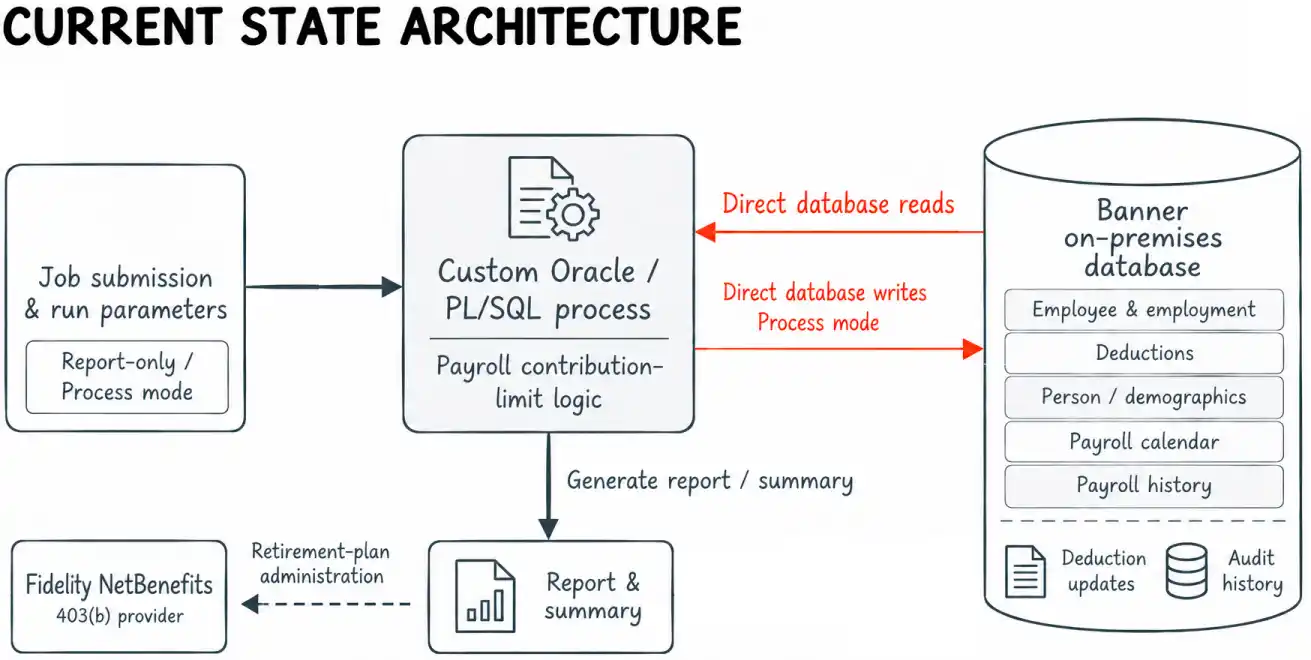
The current-state architecture focuses on the institution-side processing supporting the 403(b) retirement plan. The process generated report and summary outputs that supported the broader retirement-plan administration context with Fidelity, while its central technical dependency remained internal: business logic and direct Banner database access were tightly coupled inside the same custom process.
Rebuilding the workflow as an API-driven Data Connect pipeline
Separate data access from business-rule evaluation
ABCloudz rebuilt the process around a different execution pattern: Pull, Evaluate, Update.
Ellucian Data Connect retrieves the employee, deduction, demographic, employment, payroll-calendar and payroll-history information required by the workflow. Transformations evaluate the applicable business rules, while routing controls determine whether an employee requires no change, needs an update or must be handled as an exception.
This separates the information the process needs from the legacy database implementation that originally supplied it.
Keep report and processing paths explicit
The workflow retains the distinction between evaluation and modification. In report mode, it can calculate proposed changes and identify conflicts without writing payroll data. In process mode, qualifying updates continue through the API-based write path.
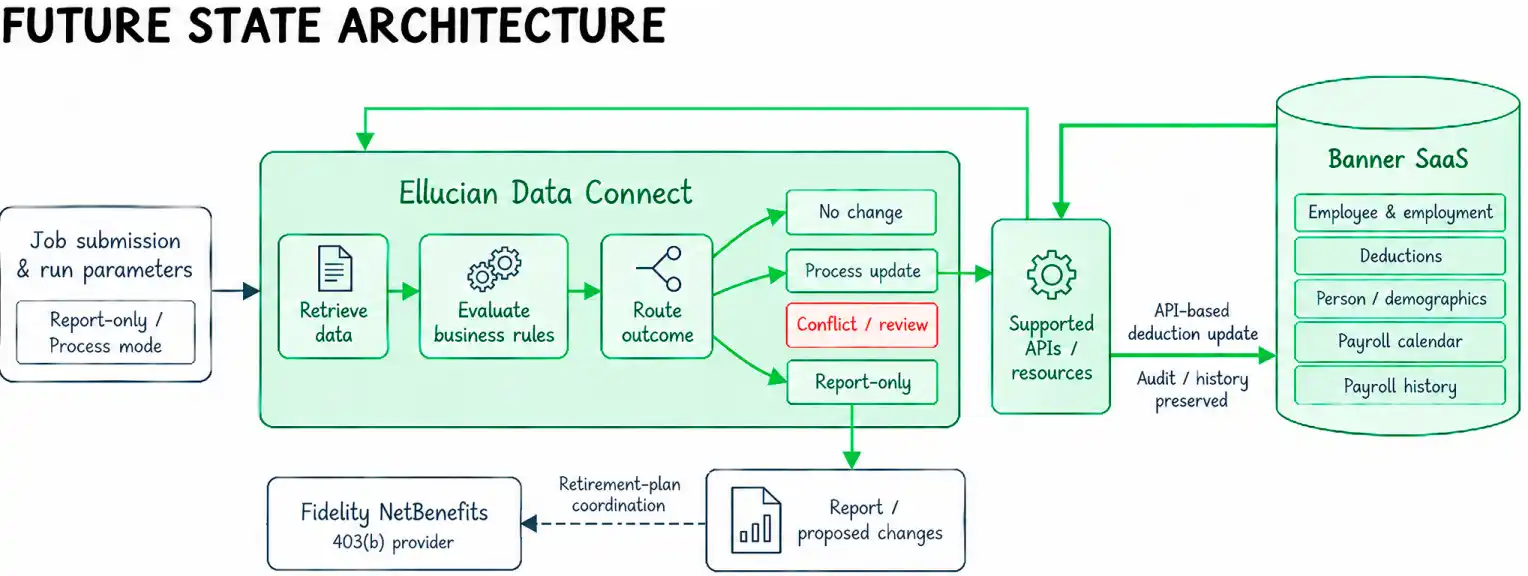
The same business process now runs through supported data access and explicit workflow logic rather than inside a database-resident program. Report and proposed-change outputs remain available for the broader retirement-plan coordination context involving Fidelity, while Banner updates follow the supported API-based path.

Preserving the payroll rules behind the legacy program

How do you preserve a date-sensitive payroll process when the implementation model changes completely?
Apply the correct age-based limit
The workflow first determines which configured employee elective-deferral limit applies to the employee. The source process uses four age bands: under 50, 50 through 59, 60 through 63 and 64 or older.
The values remain parameters. The workflow applies the appropriate configured limit instead of embedding a specific annual amount in the process logic.
Select the right effective-dated record
Effective-dated data can contain multiple versions of the same business record, with the applicable version determined by when each record takes effect. The process therefore has to establish the employee’s current deduction state correctly. For the relevant employee and deduction, it selects the record with the latest effective date that does not exceed the applicable as-of date, meaning the date against which the employee’s current state is evaluated.
That matters because selecting the wrong version of an effective-dated record could change both the comparison and the subsequent update logic.
Calculate a safe new effective date
When a change is required, the workflow derives a new effective date from several pieces of payroll context. It considers the employee’s latest paid period, current hire date, the applicable payroll-period boundary and the effective date of the current deduction record.
The workflow then checks for an existing future-dated deduction record that would conflict with the proposed change. If it finds one, the update does not proceed automatically.
Preserve auditability and controlled failure handling
The API-based processing path also preserves the audit/history behavior associated with a successful deduction update. At the same time, the pipeline distinguishes normal no-change conditions from business conflicts, invalid inputs, lookup or data issues and processing errors.
This keeps operational exceptions visible instead of burying them in a single batch result.

The real migration unit was the business rule, not the stored procedure that happened to implement it.
The resulting SaaS-compatible payroll process
The institution now has the custom contribution-limit process supporting its 403(b) retirement-plan administration with Fidelity implemented as an Ellucian Data Connect workflow rather than as an Oracle-resident program.
The Future State preserves the behavior that made the original customization useful: age-based limit selection, correct handling of effective-dated deduction records, guarded effective-date calculation, future-record conflict detection, report-only execution and audit/history preservation.
The process now retrieves and updates the required Banner information through supported API-driven patterns, with business rules and routing made explicit inside the workflow and reporting outputs supporting the broader retirement-plan coordination context.

A database-dependent payroll customization became a Data Connect workflow with supported data access, explicit decision logic, conflict controls, report-only execution and preserved auditability.
Frequently asked questions
Need to modernize custom Banner logic for SaaS?
If your institution has custom Banner jobs, database-resident business rules or integrations that need to move into a SaaS-compatible architecture, ABCloudz can help identify what each customization actually does, separate required business behavior from legacy implementation details and rebuild the needed capability using supported Ellucian patterns.
Contact ABCloudz to review your custom Banner workload and plan a practical modernization path.