
July 2026
There’s a lot of talk about how agentic AI will change software development.
At ABCloudz, we’ve moved beyond experimenting. We’ve adopted it across multiple real projects, learned what works, and seen great results.
Now we’re taking those lessons across our broader portfolio. The blogs below share examples of what we’re doing, what we’re learning, and how it’s changing the way we build and modernize software.
One developer, AI as the team

A long-term client asked one ABCloudz developer to migrate a legacy C++ payment application from an older generation of terminals to a new Android-based platform. There was no supporting delivery team and no complete knowledge transfer. The developer used AI agents across reverse engineering, architecture, implementation, code review, QA, and project coordination.
YOU MAY FIND IT USEFUL TO KNOW:
- How do you turn legacy code into an evidence-backed system specification?
- How can a project wiki give multiple agents a shared source of truth without loading the entire system into every context window?
- Where should the workflow stop and return a decision to a human?
Control AI development costs
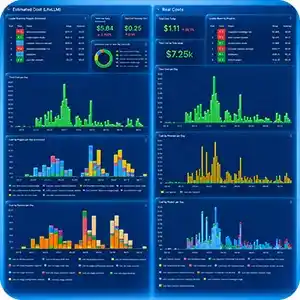
More agent activity also means more external AI usage. We built a cost-control workflow around LiteLLM and Grafana so AI requests can be attributed to projects, teams, developers, features, or service accounts instead of one provider bill. Virtual keys provide attribution, budgets and limits provide guardrails, logs explain unusual usage, and Grafana connects the operational and financial picture.
YOU MAY WANT TO SEE HOW:
- How can you set budgets and limits before requests reach AI providers?
- How do request-level logs reveal expensive models, retries, oversized prompts, or runaway workflows?
- How can the same controls be introduced when ABCloudz developers work inside a client-owned AI development environment?
How far can agentic AI automate backend development?
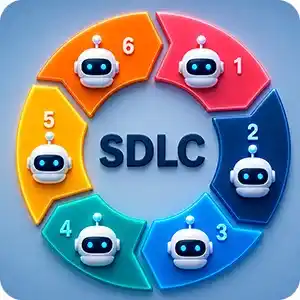
We tested an AI Orchestrator coordinating specialized agents across documentation, architecture, database, implementation, and review. As projects exposed missing information and changing requirements, autonomous orchestration increased context, iterations, cost, and complexity. We kept the agents and skills, but returned orchestration to the developer.
YOU MAY BE INTERESTED IN:
- How far can autonomous agent orchestration go?
- Why can late human review become difficult?
- How did selective agents deliver an estimated 3x speedup?
Our agentic development framework
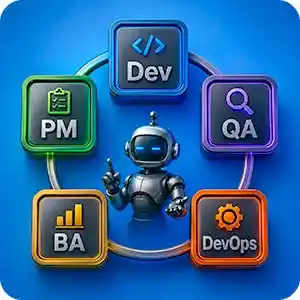
We are building a reusable framework for agentic software development. Company-wide repositories provide shared skills, workflows, architecture principles, security guardrails, and engineering standards. Project repositories add architecture, API contracts, data models, code, terminology, and business context for each engagement. The same model supports BA, PM, Developer, QA, and DevOps roles.
YOU MAY WANT TO EXPLORE:
- How can one set of company-wide AI skills be reused efficiently across multiple development projects?
- How do agents combine global engineering standards with project-specific context and delivery requirements?
- How can BA, Developer, QA, and DevOps workflows share the same knowledge model across the SDLC?
Let’s build better together with agentic AI
Explore how we bring agentic AI into software development and modernization, from project context and agent workflows to quality gates and cost controls.

Whether you are building a new application, modernizing a legacy system, or introducing AI into an existing engineering organization, ABCloudz can help design the workflow, agents, project context, quality gates, and cost controls around the way your team actually works.