By Mariia Horova | Senior Full Stack Engineer
We already knew that AI agents could help with substantial backend development tasks.
The more interesting question was how far we could take that idea. Could we connect specialized agents into a workflow that would move a feature through documentation, architecture, database work, implementation, and review with minimal human coordination?
That is what we tried.
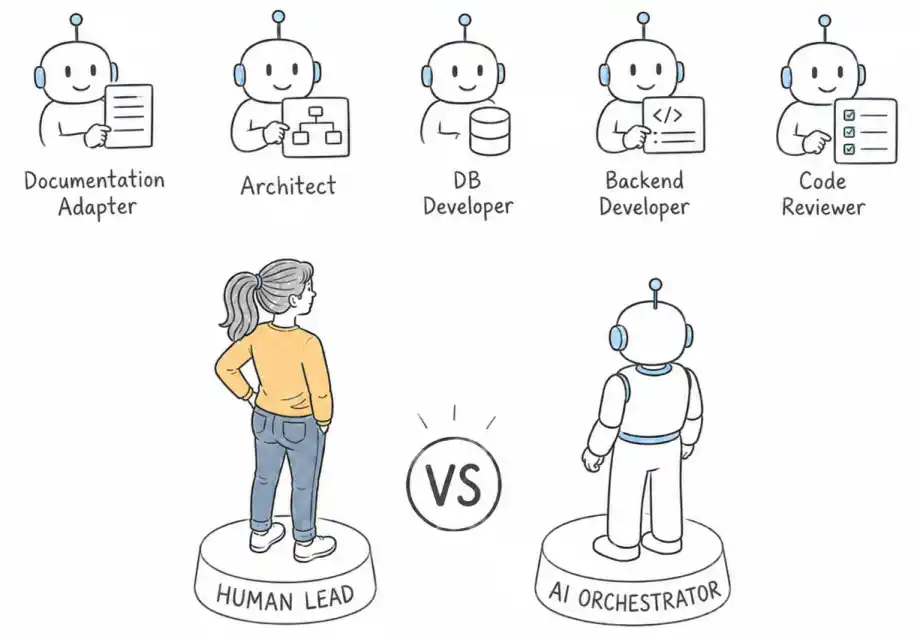

How far can we automate backend development with AI agents before we start losing useful control?
What we learned was not that agentic AI should be limited to coding assistance. Specialized agents can take on much more.
The harder part is deciding who should orchestrate them.
The ideal model was an AI-orchestrated workflow
The natural next step was to connect specialized agents into one coordinated pipeline.
Instead of a developer manually deciding what to ask next, an Orchestrator could inspect the workflow, call the appropriate agent, pass its output forward, collect questions, and continue until the feature reached review.

Let an AI Orchestrator coordinate specialized agents through a backend feature while humans step in only where judgment is required.
On paper, the model was attractive.
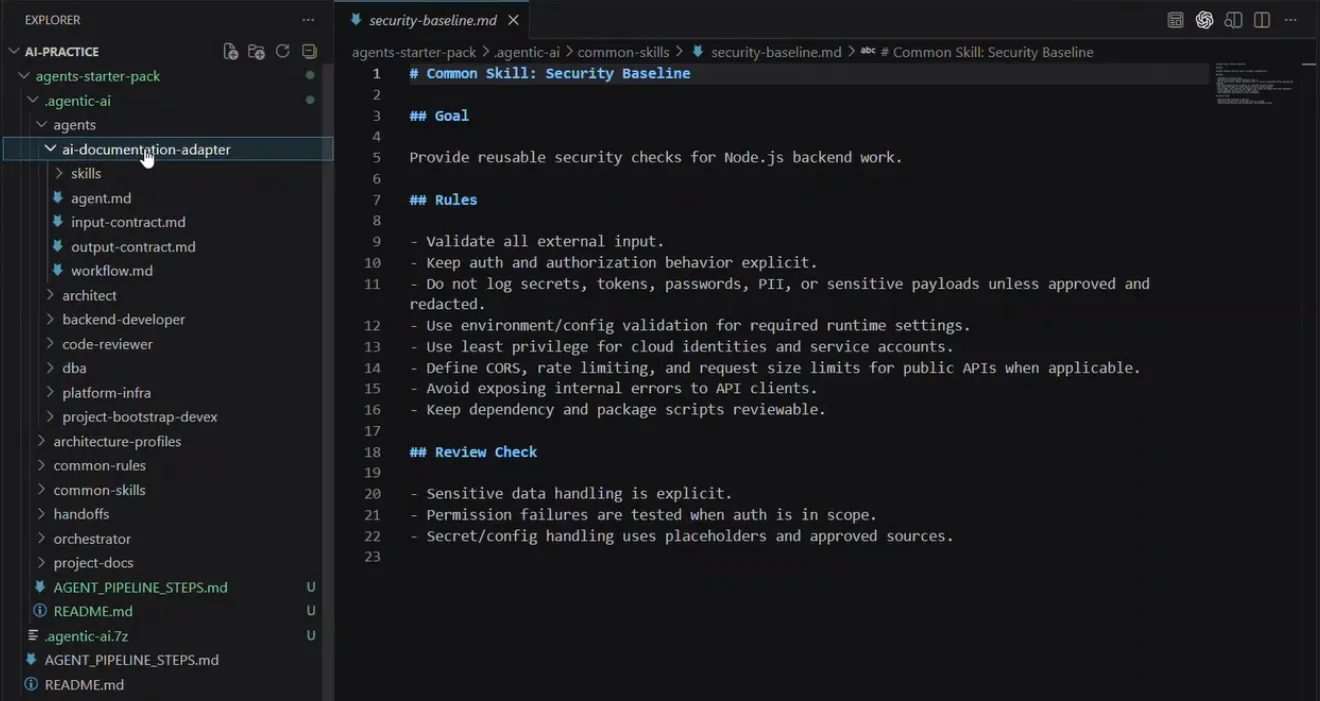
A Documentation Adapter could prepare project knowledge. An Architect Agent could define the technical direction. A Database Developer Agent could handle persistence. A Backend Developer Agent could implement the feature. A Code Review Agent could verify the result.
Agents could exchange structured handoffs, and the Orchestrator could keep the process moving.
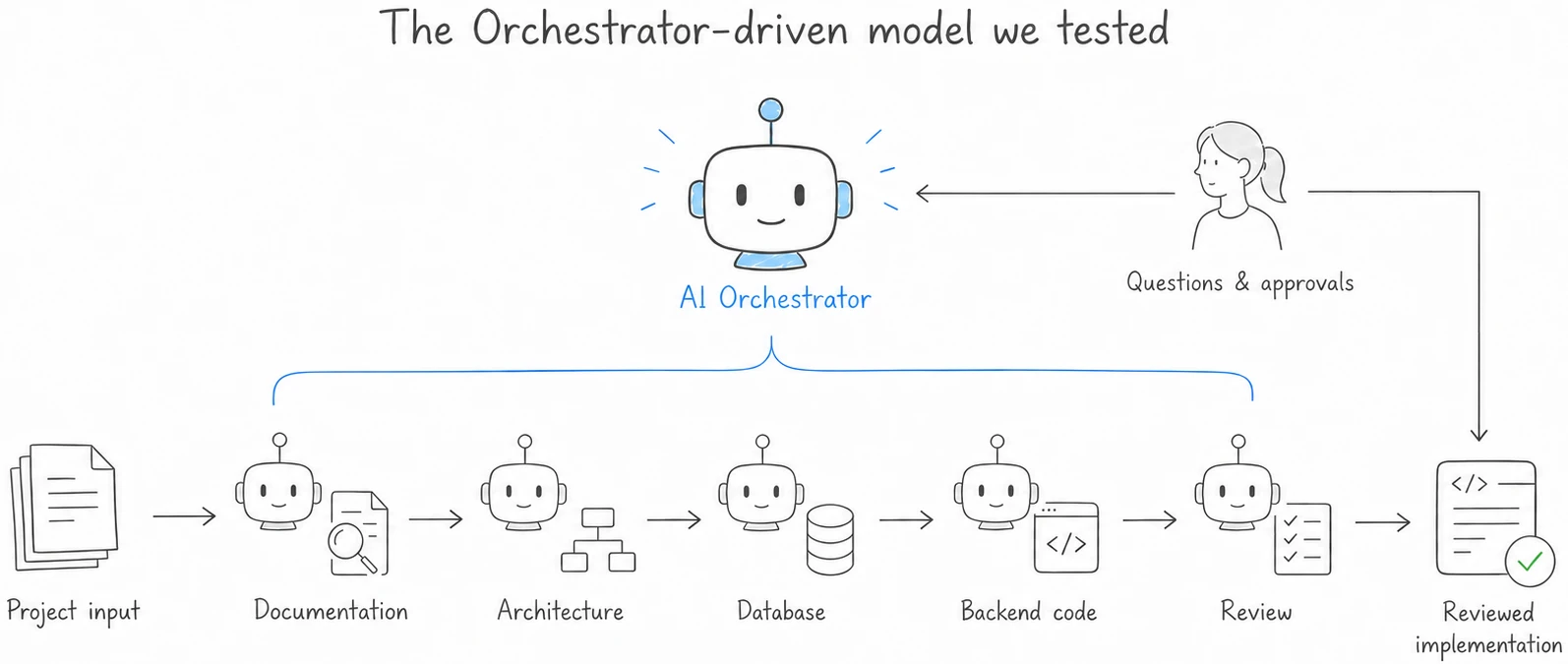
The idea was simple: reduce manual coordination and let the agent system carry more of the delivery process itself.
But that model depended on one important assumption.
The agents needed enough reliable information to keep moving in the right direction.

Real projects rarely provide complete input upfront
The ideal workflow becomes much harder when it meets real software development.
Requirements are not always complete at the beginning of a feature. This is especially common in startup and agile projects, where the product and implementation evolve together.
Some information only appears when development starts.
An API may behave differently from its documentation. An integration may expose a constraint nobody knew about. An architecture assumption may turn out to be wrong. A simpler implementation may become visible only after someone starts working with the real system.
That is normal development.

Some of the information needed for a correct implementation does not exist at the start of the task. It appears only when development exposes the real behavior of the system.
A human developer naturally reacts to that new information.
We stop. We ask a question. We change the requirement. We revise the architecture. We abandon part of the original plan.
A fully orchestrated agent chain has a harder problem.
It still needs to decide what to do next.
Uncertainty made autonomous orchestration expensive
When the autonomous workflow did not have enough certainty, it did not necessarily stop.
The Orchestrator and its agents could continue loading context, interpreting the available information, producing handoffs, retrying work, and passing results between roles.
The more complex the feature, the more expensive that process became.

An autonomous chain can keep spending context and tokens while trying to resolve uncertainty that actually requires a human decision.
This became particularly visible on larger tasks.
A complex feature may require substantial project context. Different agents need different parts of it. The Orchestrator itself also needs enough information to coordinate the workflow.
If an agent produces an unsatisfactory result, another iteration adds more work and more context.
The system can therefore stay very busy without necessarily becoming more certain that it is solving the right problem.
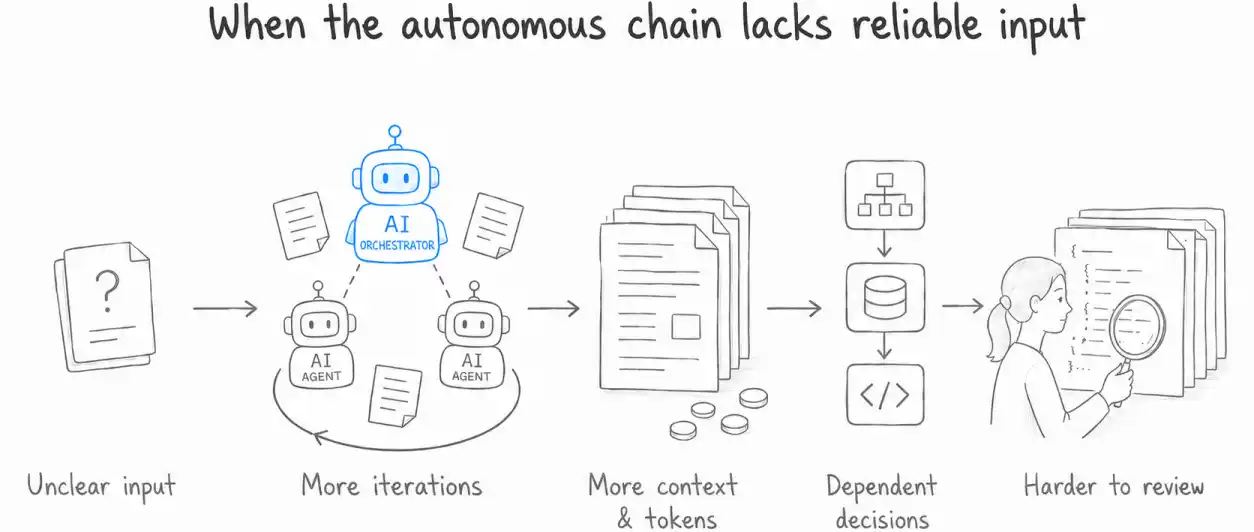
Cost was only one part of the problem. The further the chain moved, the harder it became to understand how the final implementation had arrived at a particular decision.
Final review can come too late
The deeper problem with a long autonomous chain is not whether the final code compiles. It is whether a human can still understand the decisions that produced it.
Imagine that an early architecture assumption is wrong.
- The Database Developer Agent may build on it.
- The Backend Developer Agent may then build on the database decision.
- The Code Review Agent may inspect code that is internally consistent with those previous outputs.
By the time a human reviews the final implementation, the original assumption may be buried several decisions back.
If several agents make dependent decisions before a human checks them, reviewing the final code can turn into reconstructing the entire decision chain.
At that point, the workflow starts behaving like a black box. The code may show what was implemented without making it easy to understand why the system moved in that direction.
And if the direction was wrong, correcting the final code may not be enough. Earlier technical decisions may also need to be revisited.
That changed how we thought about human review.
Human control is most useful close to the decisions that can change the direction of the work, not only at the end of the pipeline.
We removed the AI Orchestrator, not the agents
That experience did not make us stop using specialized agents.
We changed who orchestrates them.

We kept the specialized agents and their skills, but put the developer in the Orchestrator role.
The developer now decides which agent is useful for the current feature, what context it needs, what output should be reviewed, and whether another agent should be involved at all.
For a complex feature, I may start with the Architect Agent.
I can review its proposal, correct the direction, and only then pass the relevant handoff to a Database Developer Agent or Backend Developer Agent.
If a new requirement appears, I can stop the chain immediately.
If a task is faster to do manually, I do not need to invoke an agent simply because one exists.
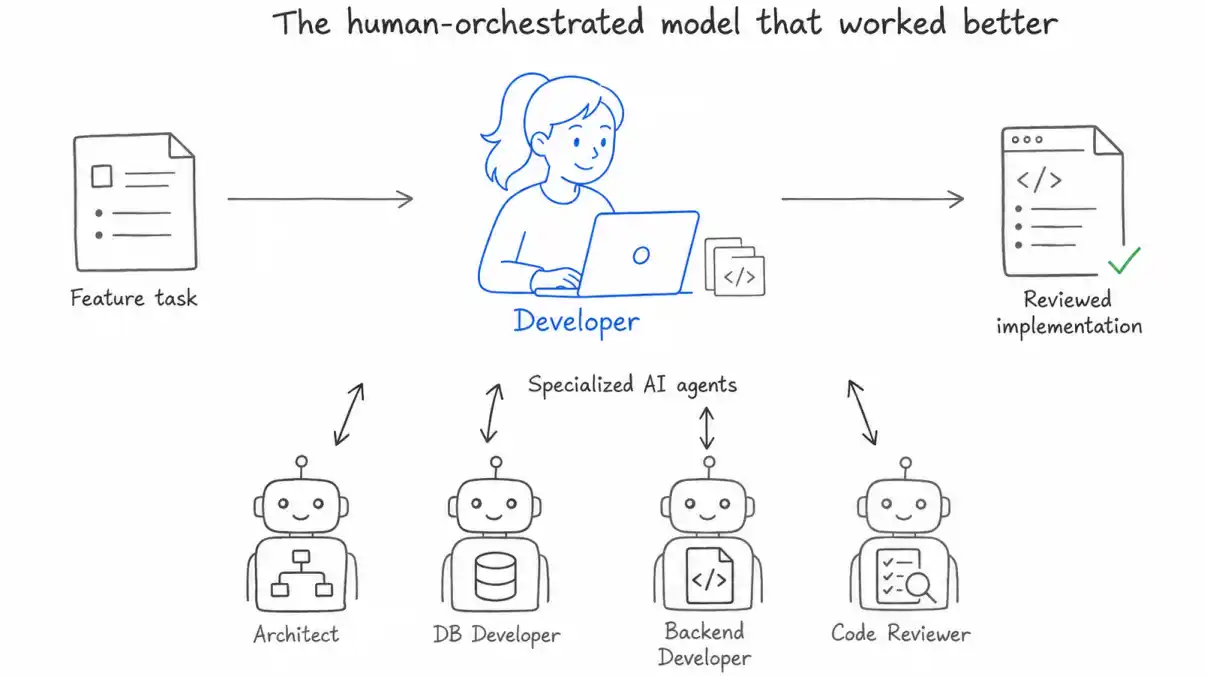
This changed the workflow from autonomous orchestration to selective AI assistance at the points where it actually added value.
More automation was not automatically better
Human orchestration did not mean returning to manual development.
The agents could still do substantial work.
What changed was that automation became selective.
The most effective agentic workflow was not the one with the most automation. It was the one where the developer could decide when automation was worth using.
That gave us several practical advantages.
- Wrong assumptions could be corrected earlier.
- Agents could work with narrower context.
- Unnecessary iterations were easier to avoid.
- Token consumption was easier to control.
- And review happened closer to the engineering decisions that actually mattered.
Sometimes the best choice was still to write the code manually. If I already have a familiar authentication service and can reuse it quickly, spending significant time explaining the task to an agent may not make sense.
For another task, an Architect Agent may save substantial time. For another, a Backend Developer Agent may be enough.
The workflow does not need to be identical every time.
We kept the speed benefit
The point of putting the developer back into orchestration was not to slow AI down. It was to keep the acceleration while making the process easier to control.
In the early sprints, one developer estimated that this AI-assisted way of working made him roughly three times faster, even without using an AI Orchestrator to run the entire workflow.
That is an important distinction.
The productivity gain did not require maximum autonomy. It came from using specialized agents where they could remove meaningful engineering work while keeping a human close to the decisions that could change the direction of the feature.
Human orchestration gave us better control without giving up substantial AI acceleration.
So how far should we automate?
Our experiment did not show that autonomous orchestration can never work.
It showed where we became uncomfortable relying on it for the kinds of evolving backend projects we were building.
When requirements are incomplete, technical knowledge emerges during implementation, and engineering decisions depend on one another, moving too much orchestration to AI too early makes the workflow harder to control and review.
For us, the more reliable model today is human-orchestrated agentic development.
Specialized agents can still prepare documentation, explore architecture, work with databases, implement features, review code, and apply reusable skills.
But the human stays close to the points where requirements, architecture, implementation direction, and acceptance decisions can change.
The useful question is not how much of the SDLC AI can automate. It is where removing the human starts making the workflow harder to control than the automation is worth.
That is the boundary we are continuing to explore.
Bring agentic AI into your development process
Agentic AI can support much more than code generation, but getting useful results requires more than connecting agents together.
The roles, skills, context boundaries, review points, cost controls, and human decision gates all matter.
If you are introducing agentic AI into backend development, ABCloudz can help design the workflow around the way your team and your software actually work.