Moving to Ellucian Banner SaaS does not erase academic logic.
It just refuses to run it the old way.

That was exactly the situation here. The institution already had working logic that updated module outcome related values based on student grading data. Academic teams trusted it. The rules were established. The process was already doing real work. But once Banner moved from on-prem to SaaS, the old execution model hit a wall.
The challenge was not to invent a new process. The challenge was to preserve an existing one without sanding off the details that made it academically meaningful in the first place. Module scores, component grades, assessment comments, progression-related conditions, timing in the grading lifecycle, all of that still mattered. The difference was that now the logic had to run through Ellucian-supported SaaS tools.
Using Ellucian Data Connect and Ethos APIs, ABCloudz rebuilt that decision flow as a cloud-native process inside Banner SaaS.
In this post, we show how that logic was reconstructed, how the new flow handles different grading stages, and how a rule-heavy academic process can be modernized for SaaS without turning it into something generic.
We have delivered similar Banner and Colleague SaaS modernization work across integrations and custom logic, using the same approach of uncovering the real behavior inside legacy processes and rebuilding it with Ellucian-supported tools.
The logic stayed. The environment changed.
Before moving to SaaS, the institution already relied on automated logic that evaluated student performance and assigned outcome-related values used in academic progression.
These outcomes were not simple calculations. They depended on combinations of signals such as final module scores, grades for individual components, comments from assessment elements, and academic conditions that influence how results should be interpreted.
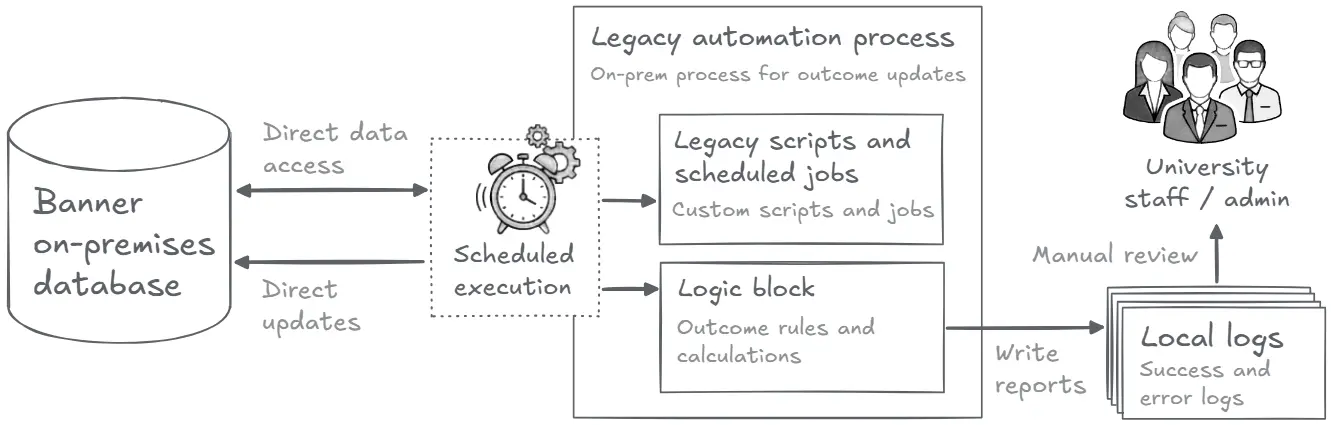
It also had to work in two very different moments of the grading lifecycle: while grades were still being worked on, and after grades had already been rolled into academic history. That distinction matters, because the same academic rule can require different handling depending on where the record sits in Banner.
The logic already existed. The challenge was expressing that logic in a way that fits Banner SaaS, where direct database interaction is no longer possible.
Rebuilding the logic for SaaS
ABCloudz implemented the solution as two coordinated Data Connect pipelines that operate through Ethos APIs and update Banner SaaS using supported endpoints.
The pipelines separate processing based on grading lifecycle stage. One pipeline evaluates results before grades are rolled. The second evaluates records after grades become part of academic history. In Banner, these two stages behave differently and require different update logic. Handling them as separate flows avoids timing conflicts and ensures updates are applied to the correct academic context.
Each run starts by defining the academic scope. The pipelines can be executed for a specific term, part of term, academic level, program, department, course, or selected student population. This allows institutions to run the process for targeted academic segments instead of processing the entire dataset every time. It also makes reruns safe when corrections or late grading changes occur.
After defining the scope, Data Connect retrieves academic structure and enrollment context through Ethos APIs. This includes academic periods, course enrollments, and student registration data required to evaluate outcomes. Filtering happens before business rules are applied, ensuring that the logic runs only on relevant academic records.
Business rules are implemented as transformation steps within the pipeline. These rules evaluate multiple grading signals together, including overall module result, assessment-level grades, comments, grade changes, and conditions affecting resits or deferred outcomes. Outcome decisions are therefore based on the academic relationship between grading elements rather than a single field comparison.
The solution also aligns processing with Banner’s grading configuration by evaluating only records considered gradable within the system. This avoids relying on static assumptions and ensures the process adapts to institutional grading setup.
Once the appropriate outcome is determined, the pipelines construct structured update requests and send them to Banner SaaS through Ethos APIs. Updates are applied using controlled PUT operations, ensuring compatibility with Ellucian’s supported integration patterns.
Each pipeline run generates structured CSV reports showing successful updates and exceptions. These reports are stored in Amazon S3, providing institutional staff with a clear review layer and supporting operational transparency without requiring direct system access.
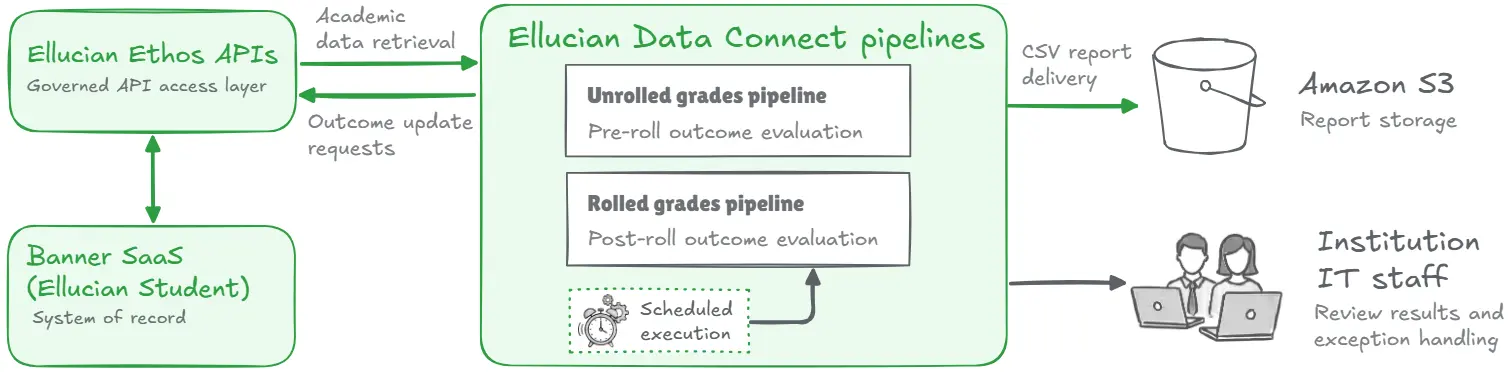
The final architecture combines Ethos for governed API access, Data Connect for orchestration and transformation logic, and S3 for operational reporting. The result is a controlled, repeatable process that preserves academic decision logic while fully aligning with Banner SaaS integration standards.
Results
The institution now has a cloud-native process that preserves the intent of its academic logic while aligning fully with Banner SaaS architecture.
Outcome related values can be calculated consistently both before and after final grade posting. Staff can run the process for specific academic populations when needed. Results are transparent and easy to review.
The academic meaning of the process remains the same. The technical foundation is now ready for the SaaS environment.
Modernizing Banner logic for the SaaS model
ABCloudz helps institutions translate existing Banner behavior into SaaS-ready solutions using Ethos APIs and Data Connect. By focusing on how academic decisions are actually made, we rebuild processes in a way that remains familiar to stakeholders while fitting Ellucian’s cloud architecture.
If your institution is preparing for Banner SaaS and has existing logic that cannot simply be retired, we can help modernize it without losing the structure behind it.
Let’s talk about how to bring proven academic workflows into a SaaS-ready model.