Integration delivery often becomes more difficult than it should be before implementation even begins. The technical work may be ahead, but the first real obstacle usually appears earlier, when a team tries to establish a dependable understanding of the integration itself.
Sometimes that understanding is scattered across prior projects, architecture notes, repositories, and vendor materials. Sometimes the available information is incomplete, inconsistent, or no longer current. Sometimes there is no clear internal precedent at all, which means the team has to build a working picture from external sources while deciding what is reliable enough to trust. In all of these cases, delivery slows for the same underlying reason: the starting point is weak.
That is the problem Integration Knowledge Hub is designed to solve.
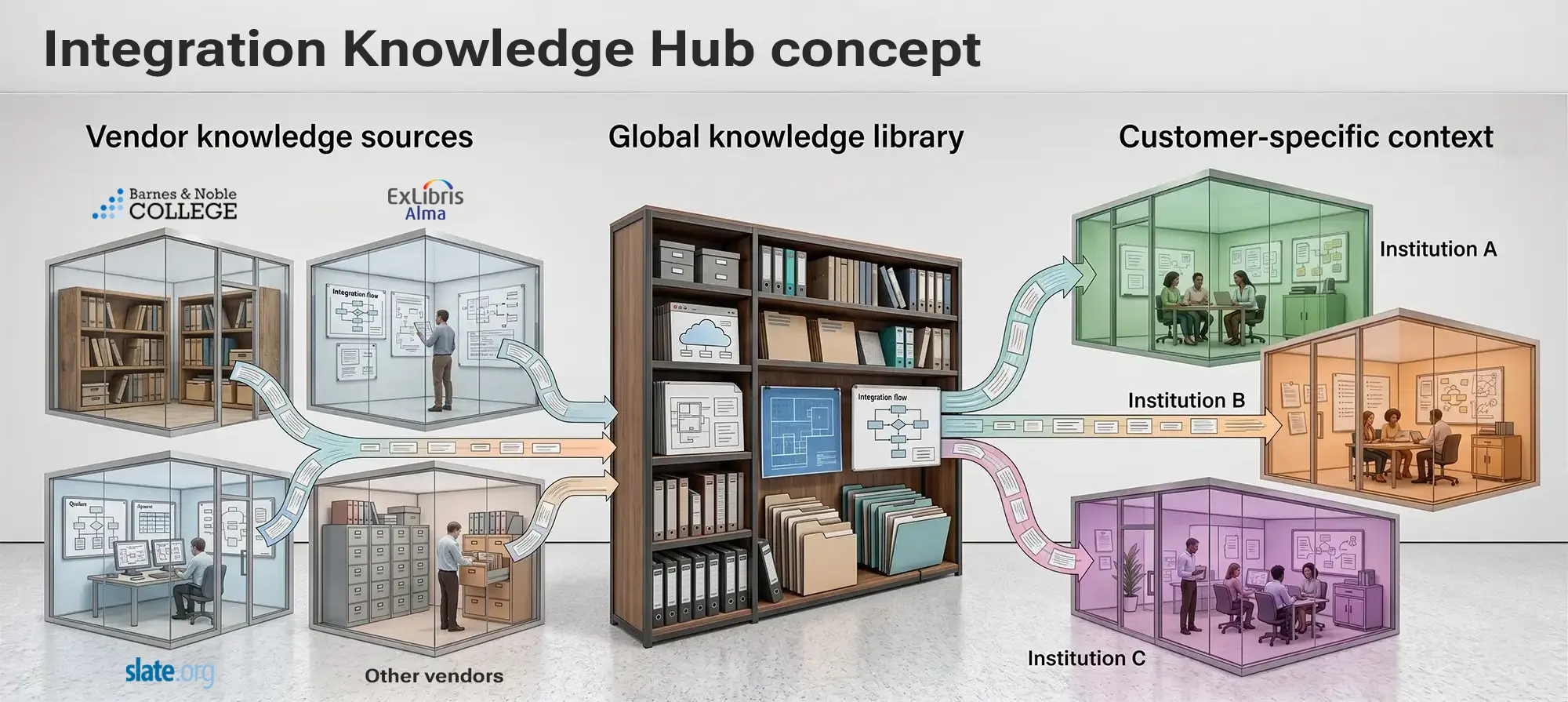
Shaped by extensive hands-on delivery experience, especially across hundreds of projects in the Ellucian ecosystem, Integration Knowledge Hub is ABCloudz’s approach to creating a stronger starting point for integration work. It is designed to assemble, organize, and continuously improve knowledge about integrations with specific third-party systems so teams can move into delivery with more clarity and less avoidable rework.
While this challenge is especially familiar in higher education, it is not limited to one sector or one platform. Organizations working across growing integration portfolios encounter similar challenges in many other industries as well.
How the solution reduces repeated discovery
Integration Knowledge Hub is designed around a simple idea: knowledge gained from one integration should not remain locked inside one project.
When a team has already implemented an integration with a specific third-party system, the useful understanding from that work should be reusable beyond the original delivery context. That includes knowledge about how the integration works, which interfaces and constraints matter, what technical patterns proved effective, and what implementation considerations are most likely to shape future work.
Integration Knowledge Hub helps turn integration experience into a reusable knowledge asset that can support future users of the platform, including other universities, other organizations, and other delivery teams facing the same third-party system in a different environment.
That changes the model in an important way. Instead of treating each new integration request as an isolated discovery exercise, the platform makes it possible to build on what has already been learned elsewhere. And when no prior implementation knowledge is available, the same system can still assemble a stronger starting point by gathering and organizing information from external and internal sources.
The practical benefit is straightforward. Teams can get up to speed on unfamiliar integrations faster, reduce repeated research, and make better use of implementation knowledge that would otherwise remain trapped inside separate projects.
How Integration Knowledge Hub works
The architecture behind Integration Knowledge Hub matters because trust matters. If the system is going to support real delivery work, it cannot behave like a loose collection of disconnected search results.
Instead, Integration Knowledge Hub uses an agentic AI model to gather and refine integration knowledge across multiple source types. A discovery orchestration layer coordinates specialized AI agents that work in parallel across different categories of information. Depending on the use case, those agents may research vendor resources, public educational services, open web content, institutional sources such as .edu websites, ABCloudz internal sources such as SharePoint, Git-based repositories, and local files, while also connecting to vendor-facing systems through MCPs where appropriate.
That parallel discovery model matters because integration knowledge rarely sits in one authoritative place. Useful context is usually distributed across different systems, written for different audiences, and uneven in quality. Agentic AI helps reduce the manual effort of searching across that landscape by assigning different discovery tasks to different modules, then bringing the results back into one coordinated process.
The system is not designed to stop at retrieval. It also applies validation. A quality control stage helps filter weak, irrelevant, or inconsistent results before knowledge is retained for future use. A reporting workflow then helps structure useful findings into a more usable form, supported by backend services, storage, and retrieval components that make the resulting knowledge available for future reasoning and review.
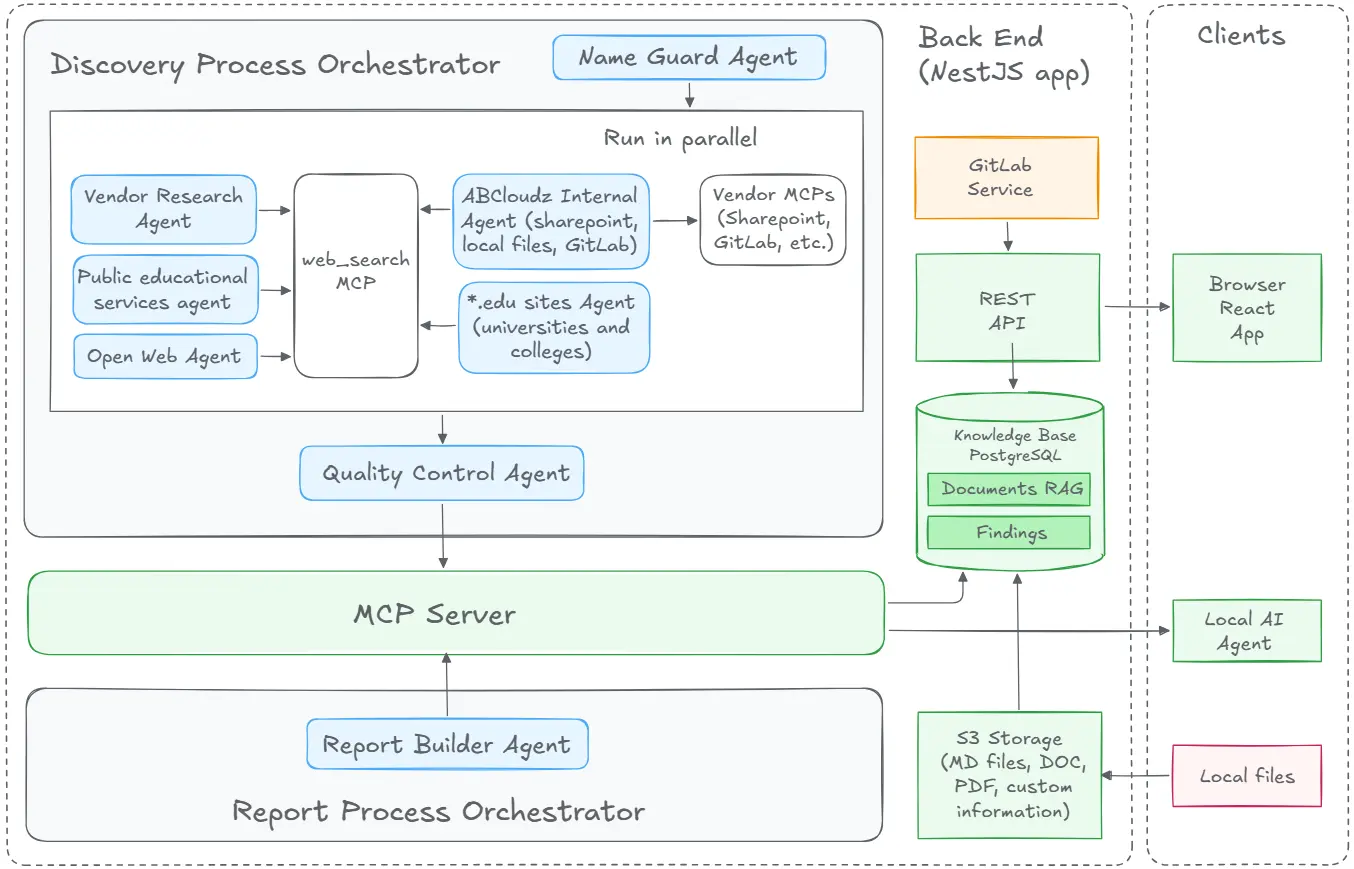
This architecture gives Integration Knowledge Hub two practical advantages. First, when an organization has already delivered a similar integration before, the system can help surface that working knowledge instead of forcing teams to reconstruct it manually. Second, when that prior foundation is weak or absent, the same system can support a more structured discovery process across approved external and internal sources, helping teams establish a stronger understanding faster than they could through manual research alone.
That is what makes Integration Knowledge Hub more than a document store or search tool. It is designed to continuously turn scattered and uneven inputs into a more dependable knowledge foundation for integration work.
Shared intelligence and customer-specific context
A scalable Integration Knowledge Hub has to balance reuse with context.
That is why it is designed around two distinct knowledge scopes. One is shared, reusable integration intelligence: generalized patterns, technical learnings, architectural approaches, and other knowledge that can support future work without being tied to one institution’s sensitive project materials. That shared intelligence is built from a broader knowledge foundation, including accumulated integration knowledge and validated inputs from external vendor-related sources. The other is customer-specific context: approved materials such as meeting notes, design documents, and project-specific inputs that belong to a particular university or college workspace.
These two scopes are connected, but they are not the same thing. Shared intelligence should inform future work broadly. Customer-specific materials should remain specific to that customer’s work. That separation allows the system to preserve what is broadly useful without collapsing everything into one undifferentiated knowledge pool.
This matters for both scale and trust. Teams need to benefit from what has already been learned, but they also need to work within boundaries that respect the reality of institution-specific projects.
Why this matters in practice
When the effort required to establish integration understanding goes down, repeated research goes down with it. Teams can make better use of earlier delivery work. New team members can get into context more quickly. Architects and technical leads can start from something stronger than a handful of disconnected artifacts and assumptions. The organization becomes less dependent on rediscovering the same knowledge under time pressure.
That changes operating conditions in a meaningful way. It shortens the path from request to understanding. It improves continuity across projects. It reduces avoidable friction around unfamiliar integrations. And it helps teams spend more of their time moving work forward instead of reconstructing the basics.
Where this can go next
Today, our focus is Integration Knowledge Hub itself. That is the part of the solution we are actively bringing forward now.
At the same time, Integration Knowledge Hub is also the foundation for a broader long-term ecosystem. In that broader vision, it serves as the Knowledge Layer of a more connected integration delivery model. Once integration knowledge becomes easier to discover, validate, and reuse, the next logical opportunity is to connect that knowledge more directly to downstream design workflows and, later, to operational visibility and feedback.
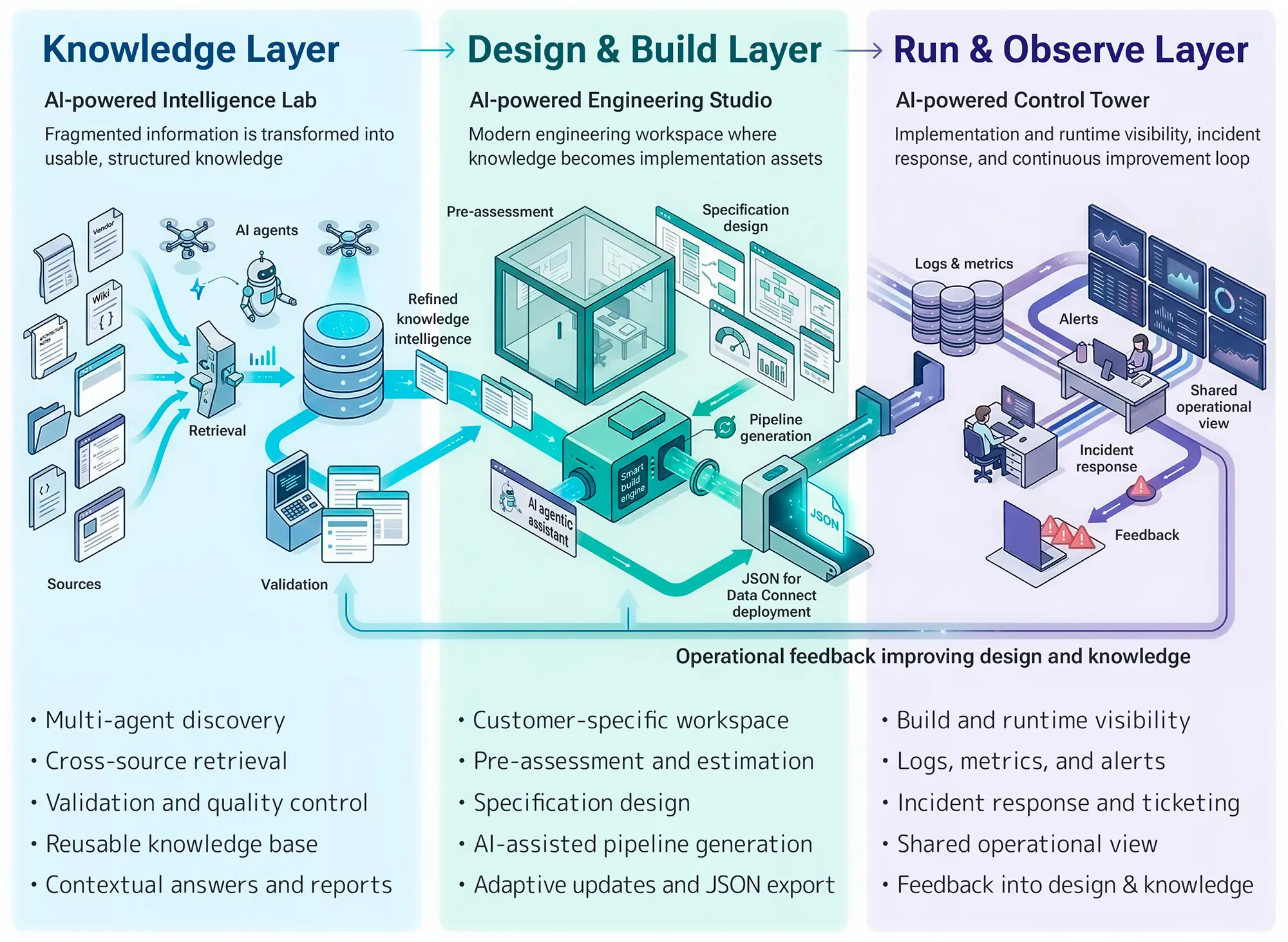
In practical terms, that broader model would create a stronger end-to-end system in which teams can move more smoothly from understanding an integration, to shaping the implementation, to observing and supporting its real-world behavior through a fuller observability approach, and to learning from operational signals over time.
See how this solution could support your team
If your team is spending too much time trying to establish a reliable understanding of integrations, Integration Knowledge Hub may offer a better starting point.
A focused walkthrough can show how this solution could fit your environment, what kinds of sources it can bring together, and where it could reduce repeated discovery in your current integration work.
Contact ABCloudz to schedule a personalized demo of Integration Knowledge Hub.