The move to SaaS does not erase your business logic, but it does erase how you used to run it.
That was the situation faced by a U.S.-based college after moving from Banner On-premises to Ellucian Banner SaaS (Ellucian Student). One of its long-running integrations, responsible for keeping specific student status data accurate and up to date, could no longer operate in its original form. Not because the process was flawed, but because it depended on direct database access, a pattern that does not exist in a SaaS environment.

Before the transition, the college relied on a custom automated workflow that evaluated student registrations each term, applied program-specific rules, and updated internal Banner records accordingly. The process was already automated and production-proven. When Banner moved to SaaS, the business requirement did not change, but the technical mechanism behind it had to.
This project was not about redesigning how the institution handled student data. It was about carefully preserving existing logic while rebuilding the integration to work within Ellucian’s SaaS model.
In this post, we share how our team analyzed the original on-premises implementation and re-created it using Ellucian Data Connect and Ethos APIs. The outcome delivers the same results the college relied on before, now running as a secure, SaaS-aligned integration built for Banner SaaS.
Why the on-prem logic no longer worked in SaaS
Before the SaaS transition, this college already had a reliable automation in place. A custom process evaluated student registrations each term, applied program and status rules, and updated Banner records accordingly. It was triggered manually by term but executed fully automatically once started.
The entire workflow was built around direct database access. SQL scripts queried enrollment and student data, applied business logic close to the source, and wrote updates straight back into Banner. That approach was efficient, predictable, and well understood in an on-prem environment.
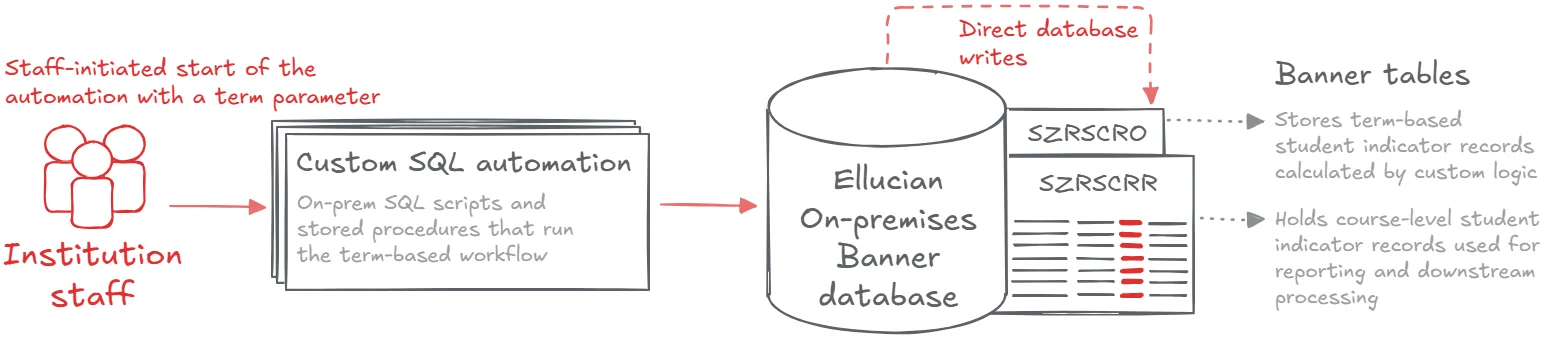
That tight coupling to the database was also its limitation.
Once the college moved to Ellucian Banner SaaS, direct SQL access, stored procedures, and background update scripts were no longer available. Any interaction with Banner now had to flow through Ellucian’s supported SaaS interfaces. As a result, the existing automation could not run as it was, even though its logic remained valid.
Turning legacy SQL logic into SaaS-native workflows
At its core, this project followed a simple principle: keep the logic, change the mechanics. The automation already worked. What needed to change was the way that logic was delivered inside a SaaS environment.
Extracting the logic from SQL
We started by treating the on-prem SQL as a source of truth. Queries, conditions, and joins were translated into explicit decision rules: how students are selected per term, when records should be created versus updated, and which edge cases require special handling. Those rules became the functional blueprint for the SaaS solution.
Designing a SaaS-native execution model
With the logic defined, we shifted focus to execution.
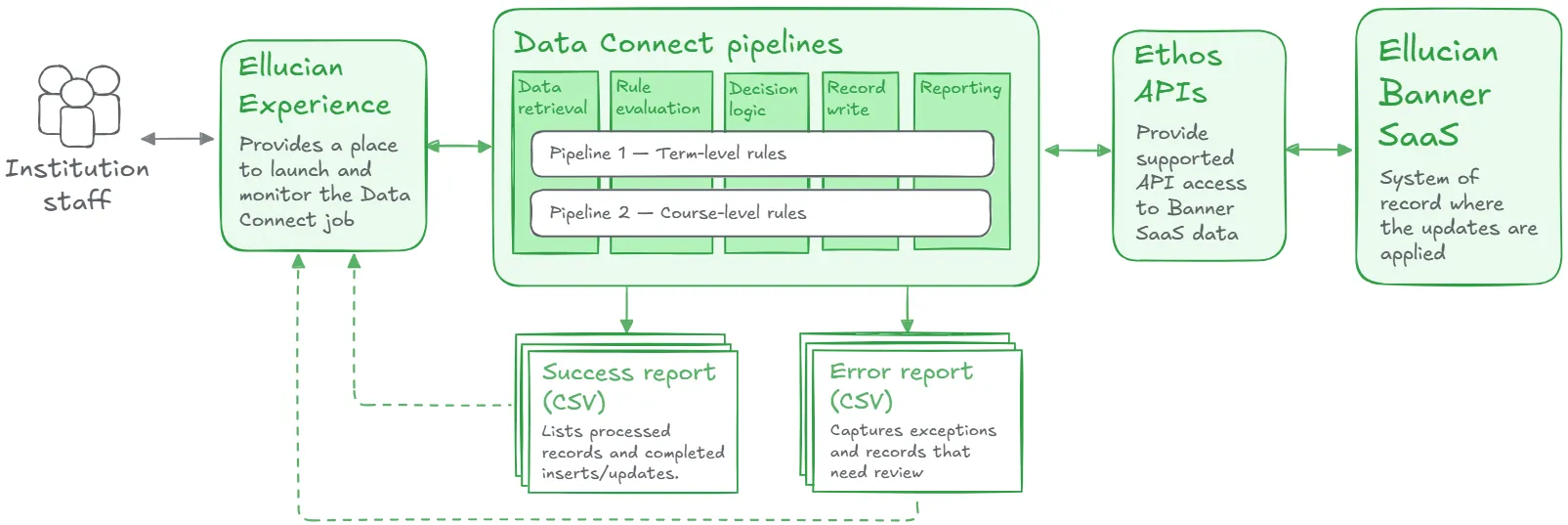
Ellucian Data Connect became the orchestration layer, while Ethos APIs provided controlled access to Banner SaaS. Direct database writes were replaced with authenticated API interactions, aligning every read and update with Ellucian’s supported SaaS model.
Splitting the automation into focused pipelines
To keep the workflow clear and manageable, we separated the automation into two Data Connect pipelines. One evaluates student records at the term level and applies program-related logic. The other processes course-level registrations and applies the corresponding updates. We designed both pipelines to be triggered manually with a term parameter, so the institution could retain its familiar operating rhythm.
Executing updates with visibility and control
Each run applies the same decision logic as before, determines whether records should be inserted or updated, and executes those actions through supported APIs. We expose every outcome through clear success and error reports, making results easy to review directly in Experience without digging into logs or backend systems.
Results that matter
The institution retained its existing automation while bringing it fully into Ellucian’s SaaS model. The same term-based rules and decision logic now run through Data Connect and supported APIs, without relying on database-level access.
Execution became cleaner and more transparent. Each run is orchestrated through SaaS-native pipelines, every update is traceable, and results are surfaced through clear success and error reports in Experience.
For staff, the operating model did not change. They still run the process by term and review outcomes after each execution. What changed is confidence: the automation is now stable, auditable, and designed to work long-term in Banner SaaS, not around it.
Make your Banner automations SaaS-ready
This project reflects a common SaaS reality. Institutional logic does not disappear when systems move to the cloud, but the ways it was implemented often do. Successfully bridging that gap requires preserving intent while changing execution.
That is the focus of our Modernize integrations with Data Connect practice. We help institutions move established Banner automations into SaaS-native, API-driven workflows that are secure, traceable, and designed to last.
If your Banner integrations were built for direct database access, we can help you translate them into cloud-ready processes that continue to work as Ellucian’s platform evolves.