If an integration was designed for direct database access, a move to SaaS will ask a fair question: what is the plan now?
That question comes up for many institutions as they move Ellucian Colleague to SaaS. The platform itself delivers exactly what it promises: stability, security, and a modern operational model. But integrations that were built around on-premises assumptions do not carry over automatically. They need a new foundation.
This story focuses on one of those integrations: the outbound data exchange between Ellucian Colleague SaaS and Redrock Software’s TutorTrac.

TutorTrac plays a central role in student support operations. It depends on accurate student profiles, enrollment data, and instructor information to support tutoring, advising, and outreach. Before SaaS, that data flow was already automated and working as intended. The challenge was about preserving existing integration logic in an environment where direct database access is no longer part of the architecture.
In the SaaS model, integrations change their shape. Database queries and scripts give way to secure APIs, governed access, and managed automation. The intent behind the integration stays the same, but the way it is implemented has to align with Ellucian’s SaaS platform.
In this post, we share how we rebuilt the Colleague to TutorTrac integration using Ellucian’s native SaaS tools, Data Connect and Ethos APIs. The result is a reusable, API-driven model that institutions running Ellucian SaaS can adopt to carry proven integration logic forward, without relying on on-prem patterns that no longer apply.
We have used this same modernization pattern across multiple Ellucian Colleague SaaS integrations, including work with Rave Alert, Ex Libris Alma, Maxient, T2 Systems, and other third-party platforms.
Working on a different Ellucian challenge right now?
Our Ellucian project library and our broader Higher Education portfolio include many other modernization stories worth exploring.
The original integration pattern before SaaS
The TutorTrac integration followed a clear and well understood process. On a schedule, Colleague acted as the system of record and exported two outbound data sets that TutorTrac relied on every day.
The first data set answered a simple question: who the students are. It included identifiers, demographic details, academic context, and contact information. The second explained what those students are enrolled in, along with the instructors tied to each course. Together, these feeds gave TutorTrac the context it needed to support tutoring, advising, and student services.
From an architectural point of view, the model was straightforward. The integration was outbound, batch-driven, and one-way. Colleague produced the data. TutorTrac consumed it. There was no real-time interaction and no data flowing back into the ERP.
The output was just as predictable. Colleague generated comma-delimited CSV files with fixed structures and delivered them to a secure TutorTrac-managed location. As long as the files arrived on time and matched the expected layout, everything downstream worked smoothly.

This pattern made sense in an on-premises environment. Integration logic lived close to the database. Data extraction depended on direct access. Scheduling and file delivery were handled locally. That same model, however, does not translate directly into a SaaS architecture.
How we rebuilt the TutorTrac integration for SaaS
Recreating this integration in SaaS was not about inventing new behavior. The goal was to carry forward the same outcomes TutorTrac depended on, while replacing every on-prem assumption with a SaaS-compatible pattern.
Identifying what the integration actually does
We started by breaking the legacy integration down into its functional intent. What data is extracted. How it is grouped. When it is refreshed. And what TutorTrac expects to receive at the end of each run. Those requirements did not change. The execution model did.
Data Connect as the integration backbone
In the SaaS architecture, we made Ellucian Data Connect the foundation of the integration. All outbound logic that previously lived in local scripts was rebuilt as managed Data Connect pipelines.
We access Colleague SaaS data through Ethos APIs, which provide secure, authenticated access to the system of record. From there, Data Connect orchestrates extraction, transformation, validation, and file creation in a single, governed flow that runs entirely within Ellucian’s supported platform.
To keep the solution clean and reusable, we implemented the integration as two scheduled outbound pipelines, each with a clearly defined responsibility.
One pipeline delivers student demographic and profile data, including identifiers, academic context, and contact information for active students. The second pipeline delivers student enrollment and instructor data, covering course registrations, primary instructor assignments, and related academic details used by TutorTrac.
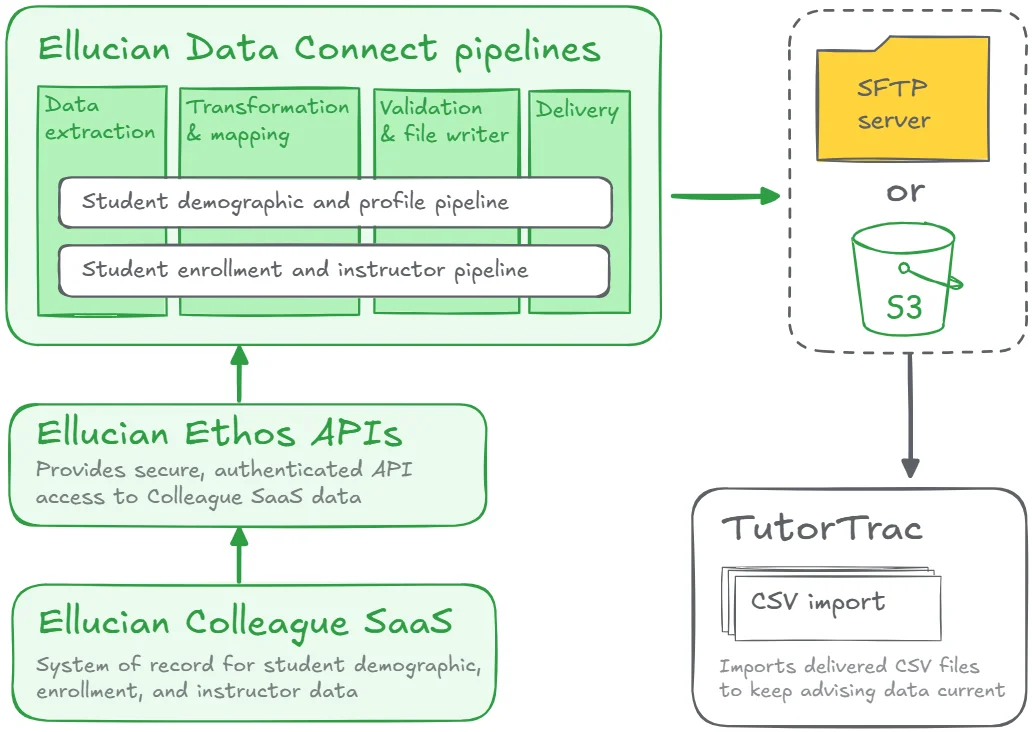
This separation reflects how the data is consumed downstream, while allowing us to keep each pipeline focused, easy to maintain, and simple to extend.
Standardizing delivery through managed file transfer
Once processing is complete, the pipelines produce CSV files that follow TutorTrac’s expected structure and delivery cadence. Files are transferred on a schedule to a TutorTrac-managed destination, allowing the platform to continue consuming data exactly as before.
The difference is architectural rather than functional. We now handle file generation and delivery as part of a fully managed SaaS workflow, without relying on local servers, custom schedulers, or institution-managed integration code.
Outcomes
The advising integration no longer relies on hidden assumptions or environment-bound implementations. Its behavior is now explicitly modeled and can be consistently deployed within Ellucian’s SaaS architecture.
This gives institutions a durable integration pattern that holds up through platform evolution, team changes, and shifting advising needs, without requiring repeated redesign.
Turn legacy integrations into SaaS-native capabilities
At ABCloudz, we specialize in helping institutions move proven on-premises integration logic into Ellucian. We use Ethos APIs and Data Connect pipelines to express integration logic as explicit, governed, and reusable SaaS workflows that align with how Ellucian platforms are designed to evolve.
If you are reviewing integrations that were originally built for on-prem environments, our Integration modernization with Ethos and Data Connect offering is designed to help you do that work deliberately and correctly from the start. Get in touch with our team to discuss your integration landscape and next steps toward Ellucian SaaS.