If your Banner automation depended on direct database access, a move to SaaS has a habit of exposing that dependency overnight.
For UK institutions running Ellucian Banner, statutory reporting is not a background task. It is a legal requirement. Each year, institutions must submit structured student data to HESA, the Higher Education Statistics Agency. This includes information about how students engage with their programs, how their studies are organized across academic years, and which modules they actually take. Regulators, funding bodies, and government departments rely on this data as the official record of higher education activity.

To support this reporting, Banner uses a dedicated set of HESA-specific records. These records do not drive day to day student administration, but they translate operational Banner data into the precise structures HESA expects for engagement, course sessions, and module instances.
One UK university had this process well under control in Banner on-premises. The logic for creating these HESA records was already automated and trusted. The catch was that this automation lived inside the database, built on scripts and processes that were perfectly acceptable on-prem, but no longer available in Banner SaaS.
When the institution moved to Ellucian’s SaaS platform, nothing about the HESA obligation changed. The reporting rules stayed the same. The deadlines stayed the same. What changed was the architecture. Direct database access was gone, and the existing automation had to be rebuilt using Ellucian’s supported cloud tools.
In this post, we show how our team modernized that statutory reporting integration using Ellucian Data Connect and Ethos APIs. The goal was not to reinvent the process, but to faithfully reproduce the institution’s existing HESA logic inside a secure, SaaS-native integration. If your institution is migrating Banner to SaaS and relies on custom reporting logic, this story offers a clear and practical blueprint for doing it the right way.
Not working on statutory reporting or SaaS migrations right now?
Explore our Ellucian-focused projects first, or browse our broader higher education work to see how we help institutions modernize their systems across the campus.
How statutory reporting worked before SaaS
Before the move to Banner SaaS, this institution already had statutory reporting under control. The automation existed, the rules were known, and the output was trusted. From a business point of view, nothing was missing.
The foundation of that setup was Banner on-premises. Engagement records were created automatically as part of enrollment, while Course Session and Module Instance records were generated through custom logic that lived close to the database. Scripts, SQL, and Banner utilities filled the gaps left by baseline Banner, using direct database access to control exactly when and how HESA-specific records were created.
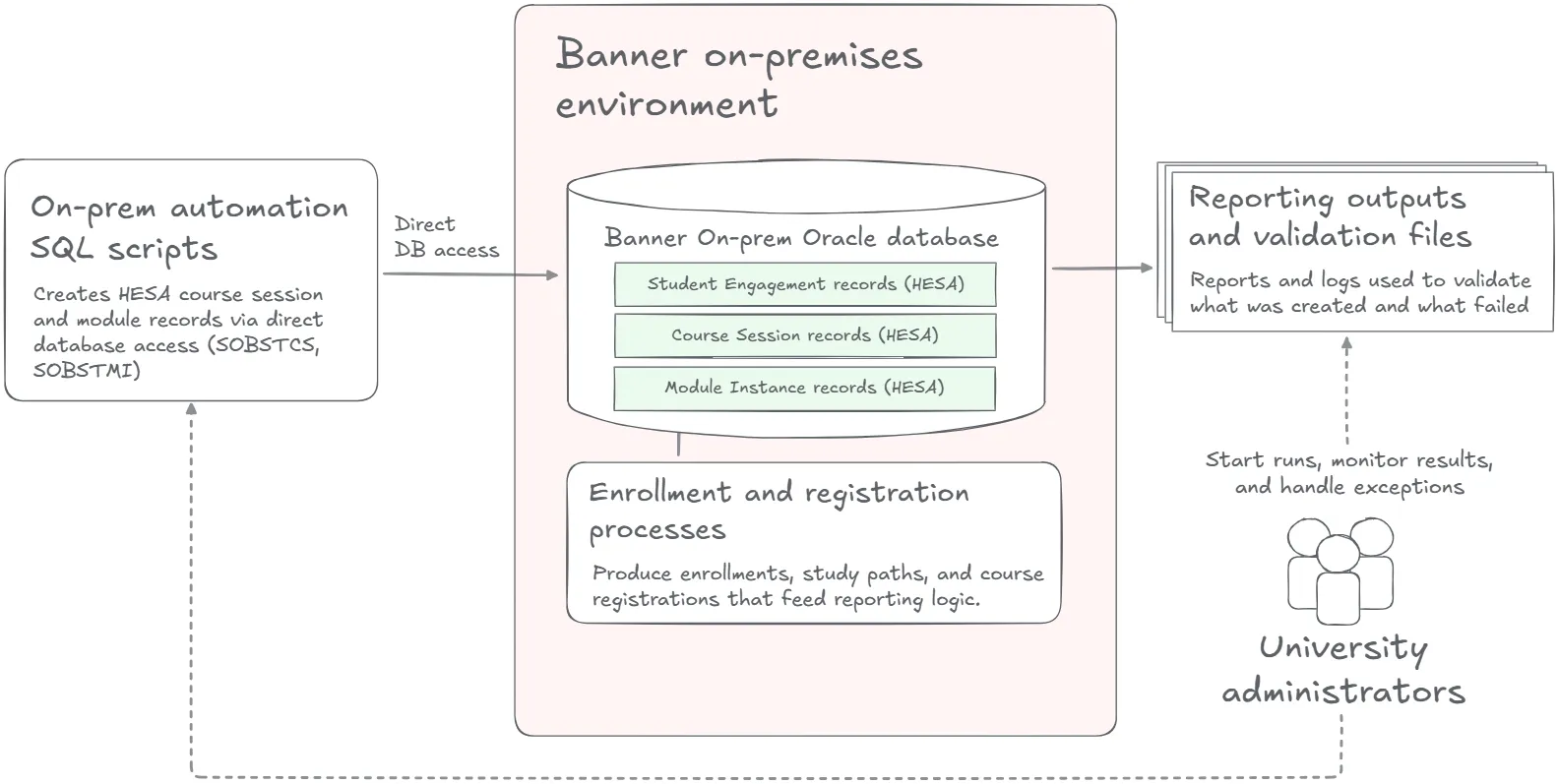
Banner SaaS removes direct database access by design. This is not a limitation, but a core principle of the platform. Security, consistency, and long-term supportability depend on keeping integrations inside controlled, API-driven boundaries. As a result, the existing statutory reporting automation could no longer run in its original form.
This automation needed to be rebuilt using Ellucian’s native integration tools. In the next section, we walk through how that legacy logic was unpacked and rebuilt inside Ellucian SaaS using Data Connect and Ethos APIs.
Rebuilding statutory reporting inside Ellucian SaaS
We started with analysis. The institution already had working statutory reporting logic in Banner on-premises, so our first job was to understand it in full. We reviewed how HESA Engagement, Course Session, and Module Instance records were created, updated, and validated. Every SQL script, rule, and dependency was treated as a user story. What triggers this record. Which students are included. How study paths, academic years, fees, and eligibility are determined. Nothing was assumed. Every decision was traced back to how the data behaved in Banner.
Once the logic was clearly mapped, we rebuilt it inside Ellucian SaaS using native integration tools. Ellucian Data Connect became the orchestration layer, while Ethos APIs provided the controlled interface for reading and writing Banner SaaS data.
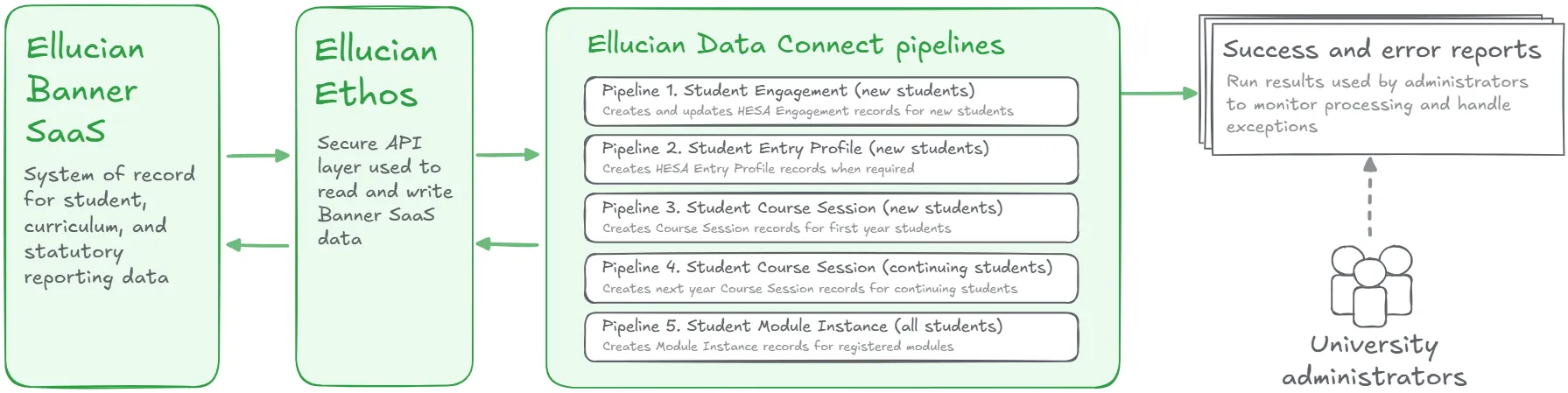
Instead of direct database access, the solution now runs as five focused Data Connect pipelines that together cover the full HESA statutory model. Each pipeline is responsible for a clearly defined part of the reporting lifecycle.
Pipeline responsibilities
The first pipeline creates and updates Student Engagement records for new students. It evaluates enrollment status and study path data to ensure engagement records exist when required and remain consistent.
The second pipeline manages Student Entry Profile records. It creates these records only when necessary and updates existing ones without overwriting valid data, preserving historical accuracy.
Course Session data is handled by two separate pipelines. One pipeline creates Course Session records for new students using first-year logic. The other detects progression and creates next-year Course Session records for continuing students, ensuring continuity across academic years.
The fifth pipeline generates Student Module Instance records for all students. It creates one record per registered module and links each instance to the correct Course Session, aligning dates and identifiers with both Banner and HESA expectations.
Core statutory data model
Each part of the statutory model is handled explicitly.
- Student Engagement records reflect enrollment status and study paths.
- Course Session records apply year-aware logic to distinguish new entrants from continuing students.
- Module Instance records represent individual module registrations with accurate start and end dates.
Across all pipelines, Data Connect retrieves student, curriculum, and registration data through Ethos APIs and applies the same business rules that previously ran on-prem. Prerequisite checks are enforced at every stage, so records are created only when the required data exists and meets defined conditions.
Every run produces clear success and error reports. Administrators can see what was created, what was skipped, and why, without relying on database-level access.
At the end of the process, all HESA-related records live natively inside Banner SaaS (Ellucian Student). The logic remains familiar, but execution is now fully SaaS-compliant, secure, and repeatable.
Results and impact
Statutory HESA records are now created natively in Banner SaaS using supported, API-driven automation. The five Data Connect pipelines run on schedule and apply the same reporting rules with predictable results. Engagement, Course Session, and Module Instance data is created only when conditions are met, reducing noise and manual intervention during reporting periods.
Administrators gain clear run-level visibility through success and error reports, making it easier to monitor processing and resolve exceptions.
The outcome is a stable, SaaS-ready statutory reporting process that preserves existing logic while aligning fully with Ellucian’s cloud architecture.
Modernize integrations with Data Connect
This project reflects a common challenge institutions face when moving Banner to SaaS. Existing reporting logic still matters, but the way it runs has to change.
This is exactly what our Modernize integrations with Data Connect offering is designed for. We help institutions transition critical on-prem integrations into Ellucian SaaS in a supported, secure, and operationally reliable way.
Contact ABCloudz to discuss how we can help.