Career services should not be the first team to discover your integration stopped updating. Handshake has zero patience for “we just migrated.”
For institutions running Colleague on the Ellucian SaaS platform, the core expectation stays the same: student demographic and academic data needs to arrive in Handshake reliably, on schedule, and in a format Handshake can actually use. The twist is that SaaS changes the rules of how you get that data out. The old shortcuts that leaned on local infrastructure or direct database-style access are simply not part of the cloud model.

That is why Ellucian asked ABCloudz to build a reusable Colleague-to-Handshake integration designed specifically for the SaaS environment. We took the legacy behavior, traced it back to real user stories, and rebuilt the flow using Ellucian Ethos APIs and Data Connect, so Ellucian can roll it out to other institutions that need the same connection.
In this post, we will show what the old approach relied on, what had to keep working after the move, and how the SaaS-ready model delivers a predictable outbound feed to Handshake, with flexible delivery options.
Not the integration you are thinking about right now?
Browse our Ellucian project collection or take a wider look at our Higher Ed portfolio to see how we help institutions modernize systems across the campus.
Current state architecture before the SaaS-ready integration
Before this reusable SaaS integration existed, the Colleague to Handshake connection usually looked like a homegrown export. An institution would pull student demographic and academic data straight from the Colleague database using local scripts and queries, shape it into a CSV, then drop that file where Handshake could pick it up, most commonly over SFTP.

That worked as long as the institution could lean on local infrastructure and database-style access patterns. But it also meant every institution ended up carrying its own version of the same burden: keeping the extract logic, the file format, and the delivery process consistent enough that Handshake stayed fed with usable data.
The other weak spot was operational visibility. When a feed is just “run on a schedule and deliver a file,” you still need a clear answer to basic questions like: did it run, did it produce data, and if something went wrong, where do you see it. Without a standard, SaaS-aligned pattern, those answers depended on how each institution had stitched the process together.
What had to keep working and how we rebuilt it for SaaS
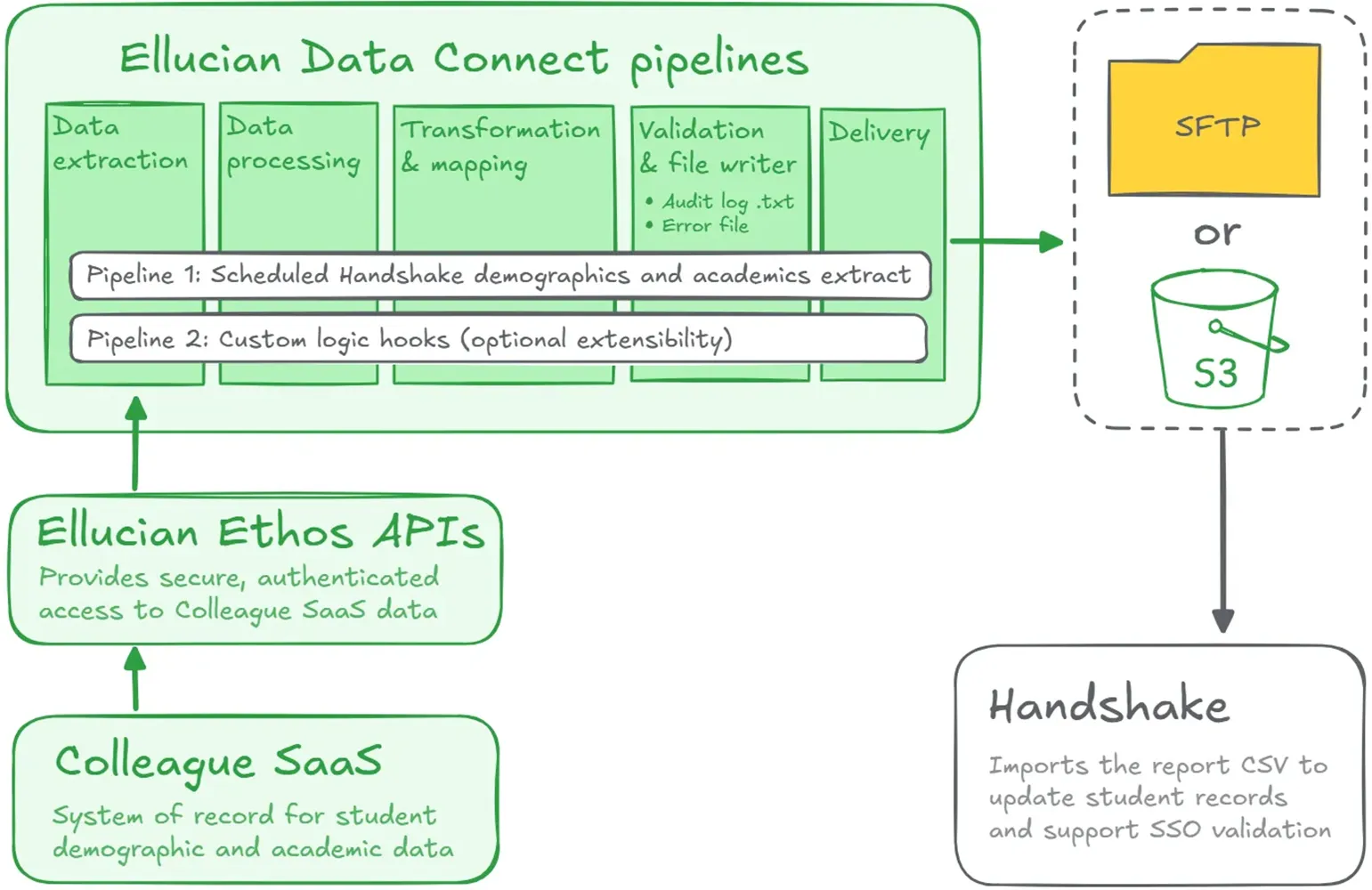
At the center of the solution is a scheduled Data Connect pipeline that moves data one way, from Colleague to Handshake. No back-and-forth sync. On each run, it exports the student demographic, academic, and contact details Handshake needs for actively enrolled students, then writes them into a report CSV that Handshake can import. And because Handshake does not make good use of half a profile, the pipeline shapes the output to include the academic context that drives matching and outreach, not just a handful of identifiers.
SSO validation needed the same kind of practicality. Handshake has to recognize a student as the right student when they sign in, so the outbound feed carries identifiers aligned with institutional credentials coming from Colleague, staying tied to the system of record instead of becoming yet another copy of the truth.
The biggest shift, of course, is how the data gets out in the first place. In SaaS there is no direct database-style access to lean on, so extraction happens through Ellucian Ethos APIs, which give secure, authenticated access to Colleague SaaS data. Data Connect then does the heavy lifting of orchestrating the run, shaping the data, and producing the file.
Delivery stays flexible because institutions do not all look the same at the edges. The same pipeline can deliver the report file through SFTP, Amazon S3, or both, using pipeline parameters rather than custom rewrites. That way, the integration stays reusable, even when the destination setup changes.
We also made sure the feed leaves a readable footprint. If a run completes with no qualifying data, a .txt audit file can be generated and surfaced under Actions in Data Connect for traceability. If something breaks, an error file is generated and users can review the message through the View Errors link on the pipeline run page. The point is simple: fewer mystery failures, less guesswork, and a faster path to “Yep, it ran” or “Here is exactly what went wrong.”
And when an institution needs something beyond the baseline behavior, the design supports extensibility. The core flow stays focused on producing the Handshake report file, while optional extensions can add custom logic and, when required, support additional artifacts like delivered audit or error files.
Results and practical benefits
The end result is a Colleague-to-Handshake integration that behaves the way institutions expect it to, even after the move to SaaS. Handshake receives a predictable outbound feed with the demographic, academic, and contact data it needs, delivered on schedule and shaped into a CSV it can actually import without extra gymnastics.
For Ellucian, the bigger win is reuse. The integration is built as a SaaS-ready pattern that captures the legacy behavior, translates it into real user stories, and implements it with Ethos APIs and Data Connect. That means Ellucian can offer the same model to other institutions that need a Colleague-to-Handshake connection, without rebuilding the flow from scratch each time.
Build your next SaaS-ready integration with ABCloudz
If your institution needs that same integration, or you have another third-party connection that needs a SaaS rewrite, we can help.
Share what you need to keep working and how it runs today. We will map the user stories, rebuild the flow with Ellucian’s SaaS-native tools, and deliver something you can run on schedule and trust.
Contact ABCloudz to get started.