When a higher ed institution steps into Ellucian SaaS, the “what” usually stays familiar. The “how” gets rewritten overnight. And integrations are where that reality shows up first.
This project is about the Ellucian Colleague SaaS (Ellucian Student) integration with Barnes and Noble Adoption, the platform that needs clean course structure, section context, user identity, and the right financial signals to support course materials and first-day access programs. For this institution, the exchange was not new. The schedules were set. The file outputs were dependable. Academic operations and accounts receivable were already leaning on it.

Colleague SaaS did not take that away. It changed the rules for how you build it. Data access moves through governed Ethos APIs. Automation shifts into managed Data Connect pipelines. The integration stops being something you run next to the SIS and becomes something you design to fit the SIS.
So for Barnes and Noble, the existing automation could not be copied forward as-is. The intent was still right. The expected outcomes were still non-negotiable. But the old implementation belonged to an on-premises playbook.
That is where ABCloudz came in. We treated the legacy integration as a set of real-world user stories rather than a pile of jobs and files, then rebuilt those stories in SaaS using Data Connect and Ethos. The result is a Colleague SaaS-native integration that delivers the same operational outputs while staying fully aligned with Ellucian’s cloud architecture.
In this post, we show how we rebuilt that integration for SaaS and what it takes to carry a long-standing Colleague integration forward without losing the value it already delivered.
We have completed similar Ellucian Colleague SaaS integration projects with platforms such as Handshake, Rave Alert, Ex Libris Alma, Maxient, T2 Systems, and other third-party solutions, applying the same SaaS-native modernization approach.
If this scenario does not match what is on your plate today, you can explore more examples from our Ellucian SaaS integrations or take a wider look at our Higher Education projects across campus systems.
The on-premises integration pattern
Before SaaS, the Colleague to Barnes and Noble Adoption integration followed a pattern that many institutions will recognize.
Colleague acted as the system of record. On a scheduled basis, it produced structured files that described academic terms, course and section structure, enrollments, user identities, and financial aid eligibility. Those files were delivered to Barnes and Noble, where they powered material selection, first-day access, and purchasing workflows. In the other direction, Barnes and Noble returned transaction data that fed directly into Colleague Accounts Receivable. Course materials had to line up with sections. Users had to land in the right roles. Charges and refunds had to post cleanly to the correct students and terms.
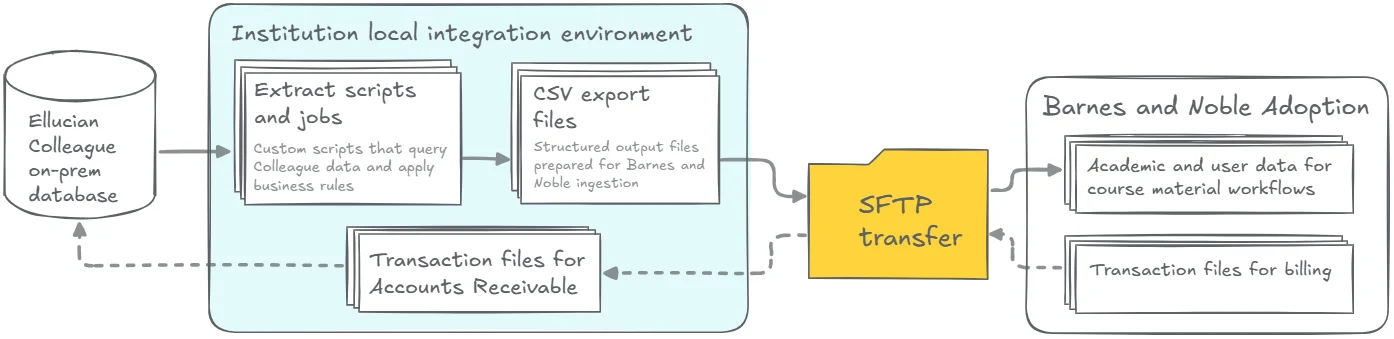
This legacy integration depended on assumptions that no longer apply in SaaS. Direct access to Colleague data structures was replaced by governed APIs. Local jobs and scripts gave way to managed, platform-controlled automation. That meant the existing automation could not simply be lifted and shifted.
Rebuilding the integration for Ellucian Colleague SaaS
To carry the integration into SaaS without breaking downstream processes, we approached the work as a set of clearly defined data flows rather than a technical migration exercise.
Defining what Barnes and Noble needs to receive and return
We began by treating the legacy integration as a contract between systems. Barnes and Noble Adoption depends on timely, consistent data about academic structure, sections, enrollments, user identity, and eligibility signals to drive course materials and first-day access workflows. In the opposite direction, Colleague depends on transaction files coming back from Barnes and Noble to post charges and refunds accurately into Accounts Receivable. Those inbound and outbound expectations set the boundaries for the SaaS design.
Outbound data flows built on Ethos and Data Connect
In the SaaS model, all outbound data now originates in Colleague SaaS and flows through Ethos APIs into Data Connect pipelines.

Academic periods, courses, sections, registrations, users, and financial eligibility indicators are retrieved through governed API endpoints, then processed by dedicated pipelines aligned to Barnes and Noble use cases.
Data Connect pipelines handle filtering, business rules, and mapping before producing structured CSV files. These files are delivered over SFTP to the Barnes and Noble Adoption platform, where they support course readiness, user access, and material selection workflows. The outputs match existing Barnes and Noble expectations, but the execution is now fully SaaS-native.
Inbound transaction processing back into Colleague
The integration also includes a controlled inbound path. Barnes and Noble generates transaction files for billing activity, which are delivered back through the configured SFTP endpoint. Data Connect retrieves these files, validates their contents, and processes them through an inbound pipeline. Charges and refunds are then posted into Colleague Accounts Receivable using supported SaaS APIs, preserving financial accuracy and auditability.
Results and impact
The rebuilt integration delivers the same operational outcomes as before, but on a foundation that fits Ellucian SaaS by design. The integration is no longer tied to local scripts, database access, or environment-specific knowledge. The logic is explicit, pipeline-driven, and easier to monitor, support, and evolve as Colleague SaaS changes.
Most importantly, the institution did not lose the value of an integration they already trusted. They carried it forward into SaaS intact, without compromises to accuracy, timing, or financial integrity.
Rebuild your Colleague integrations for SaaS
At ABCloudz, we help institutions move proven Ellucian Colleague and Banner integrations into SaaS without losing the operational outcomes they already rely on. This project shows our integration modernization offering in practice.
If you are planning an Ellucian SaaS migration or reviewing integrations that were originally built around on-prem assumptions, we can help you identify what needs to change and how to rebuild it the right way for SaaS.
Let’s talk about how to move your on-premises integrations into a SaaS-ready model.