For institutions leaving on-prem Colleague behind and moving into Ellucian SaaS, the experience often feels like landing a plane on a different runway. Same destination, very different approach.
Third-party integrations are usually where that difference becomes most visible. This story centers on the Colleague SaaS integration with Blackbaud Raiser’s Edge NXT.

Raiser’s Edge is where advancement teams manage constituent relationships, alumni engagement, and employee giving programs. The data feeding that system was already automated and dependable before SaaS. Parent relationships were established correctly. Graduates flowed into alumni records on schedule. Employee updates arrived when expected.
SaaS changed the delivery model.
Direct database access and local schedulers were no longer part of the picture. Ellucian SaaS expects integrations to run through governed APIs and managed pipelines, with clear execution paths and built-in controls.
In this project, ABCloudz reimplemented the Colleague to Raiser’s Edge integration using Ethos APIs and Data Connect. We kept the advancement logic intact and re-expressed it in a SaaS-compatible form that aligns with Ellucian’s supported tooling and can be reused across institutions. The sections below walk through how that rebuild was approached and what it looks like in a modern SaaS architecture.
We follow this same SaaS modernization approach across a wide range of Ellucian Colleague integrations, including projects with Handshake, Rave Alert, Ex Libris Alma, Maxient, T2 Systems, TeamDynamix, Barnes & Noble, TutorTrac, AdvisorTrac, and other third-party platforms where existing on-prem automation needed to be reimplemented with Ellucian SaaS-native tools.
Not the scenario you are dealing with today?
Take a look at our Ellucian SaaS integration projects or step back and explore our wider Higher Education work to see what modernization looks like across different institutions.
How the integration worked before SaaS
Before SaaS, this integration was already pulling its weight. Colleague fed Blackbaud Raiser’s Edge NXT with reliable, structured files that advancement teams depended on every day. Parent relationships stayed aligned. New graduates showed up as alumni on time. Employee records stayed in sync for giving programs. The outcomes were stable and trusted.
The original setup was built around an on-prem environment. Data could be queried directly. Jobs ran on local schedules. File delivery relied on infrastructure the institution controlled. That approach worked then because Colleague allowed it.
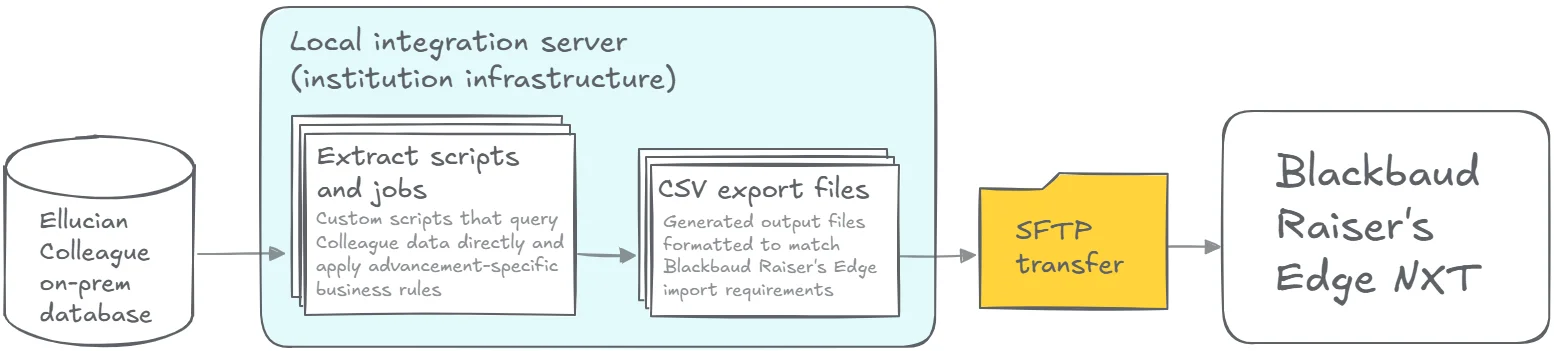
Ellucian SaaS works differently by design. Direct database access is off the table. Local schedulers disappear. Integrations are expected to run through governed APIs and managed pipelines with clear execution paths and built-in controls. The old automation could not simply move over, even though the logic behind it was still sound.
A SaaS-native execution model
Raiser’s Edge still needed the same data. Ellucian SaaS required a different way to deliver it.
The first step was stepping away from the technical leftovers of the on-prem setup and looking at the integration the way advancement teams actually experience it. Which records need to land in Raiser’s Edge. How family connections are represented. When graduates should appear as alumni. How employee data stays current for internal giving. Those expectations had already been tested in real operations, so there was no reason to rethink them.
What had to change was how that logic runs.
In Ellucian SaaS, Colleague data is no longer something you query directly. Ethos APIs become the access point. From there, Ellucian Data Connect handles execution. Scheduled outbound pipelines pull the required data sets, apply the same selection rules and mappings the institution already relied on, and check the results before anything is sent out.
Rather than forcing everything through a single flow, the integration is organized around purpose. Graduate records move through their own pipeline. Parent and family relationships follow a separate path. Employee updates run independently, on a cadence that matches HR reality. Each pipeline produces clean, import-ready CSV files for Raiser’s Edge, along with supporting report, audit, and error files that make the process transparent.
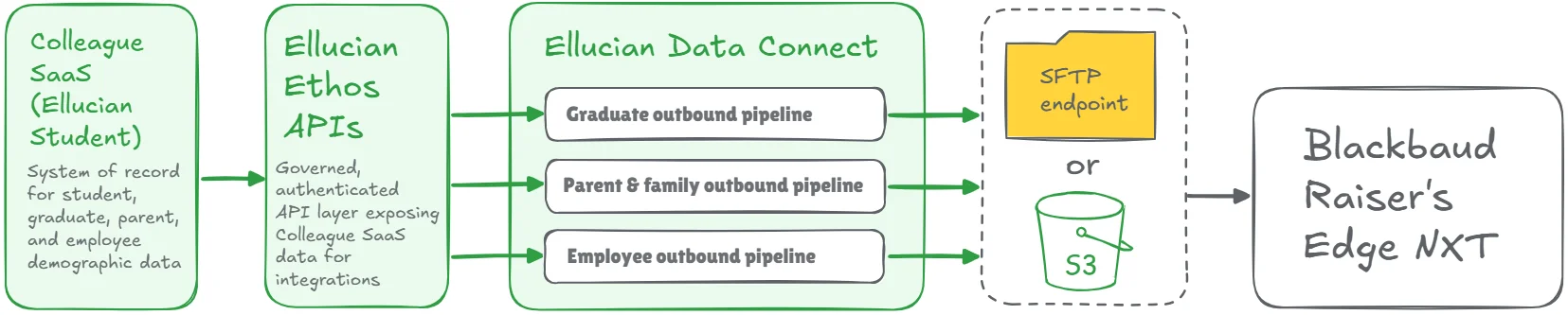
Delivery is handled directly from Data Connect to SFTP or Amazon S3. There are no local machines involved and no custom schedulers to babysit. Monitoring, logging, and notifications are part of the pipeline itself, so issues are visible as soon as they happen.
Results
The integration delivers the same data Raiser’s Edge expects, without workarounds or special handling. Graduate records arrive on time. Parent and family relationships stay accurate. Employee data stays current for giving programs.
The difference is operational. Each data set runs through its own Data Connect pipeline with clear rules, validation, and visibility. There are no local scripts, no custom schedulers, and no hidden dependencies tied to a specific environment.
For the institution, this means a stable, supportable integration that fits Ellucian SaaS as it is today and does not need to be rebuilt again with the next platform change.
Modernize integrations with Data Connect
This project is a good example of our Modernize integrations with Data Connect offering: we take an existing integration, pull out the rules that make it valuable, and rebuild the flow in a way Ellucian SaaS can run and support long-term.
If you have a backlog of on-premises Colleague or Banner integrations that now need a SaaS-ready rebuild, ABCloudz can help you prioritize what to modernize and turn those flows into repeatable Data Connect pipelines.
Let’s talk about your integration list and what it will take to modernize it.